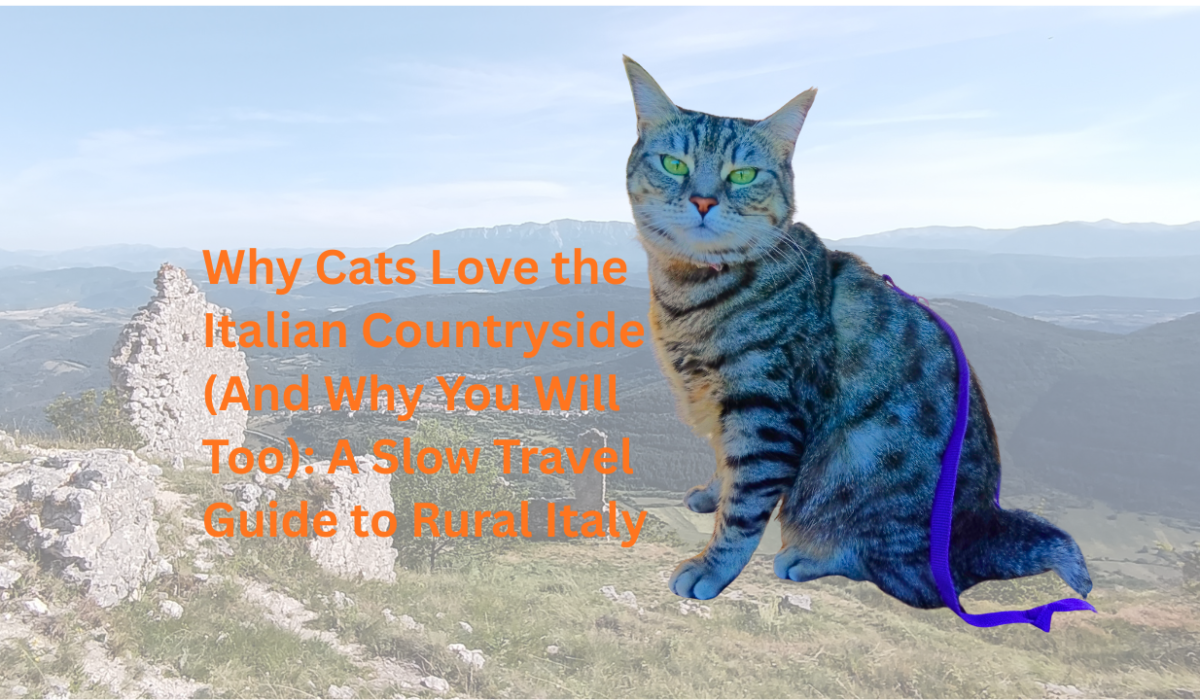
Why Cats Love the Italian Countryside (And Why You Will Too): A Slow Travel Guide to Rural Italy
Cats don’t hurry. Gigia certainly never has.
Give a cat a choice between a busy city street and a quiet country lane, and they will almost always choose the lane.
It’s not complicated.
The countryside offers everything a cat instinctively craves: open spaces, fewer strangers, interesting smells, birds to observe, long grass to investigate, warm stones to rest upon and silence broken only by wind, water and birdsong.
For humans, the same landscapes offer something equally valuable: an escape from crowds, a slower rhythm, authentic food, genuine hospitality and the chance to experience Italy as it was always meant to be discovered.
This isn’t a guide to the famous sights.
It is an invitation to experience rural Italy slowly, curiously and attentively— the way a cat naturally explores the world.
Start with our Ultimate Guide to Traveling Italy with Your Cat for the broader Italy travel framework, including transport, accommodation and practical planning.
Why Cats Feel Different in the Countryside
Cities are stimulating.
The countryside is restorative.
In cities, cats constantly process noise, traffic, crowds and unpredictable movement. In the countryside, they can often relax into a different rhythm.
The difference is tangible:
- fewer cars and trucks
- quieter streets and lanes
- natural scents instead of exhaust fumes
- birds, insects and wildlife to observe
- long grass, shaded trees and open fields
- a slower rhythm that matches their natural pace
- more opportunities for controlled exploration
Gigia’s behaviour changes the moment we leave the city behind. Her ears relax. Her pace slows. Her curiosity becomes more deliberate and less defensive.
She begins investigating rather than simply surviving.
This is one reason rural Italy fits so naturally into the broader slow travel with a cat philosophy: fewer transitions, more time in one place and an environment that allows both traveller and cat to settle into a rhythm.
Born in the Countryside, Comfortable in the City
Gigia understands both worlds better than most cats.
She was born in the Treviso countryside—a litter of kittens found in a vegetable patch, surrounded by open fields, fresh air and the rhythms of rural life.
The countryside is in her blood.
Yet she also learned to navigate cities with confidence. She has inspected Venetian canals, supervised Roman piazzas, judged Milanese shopkeepers and appeared on national television without the slightest hesitation.
She is comfortable in both worlds.
But the moment her paws touch grass again, something changes.
She revives.
Her step becomes lighter. Her curiosity more playful. Her contentment more visible.
The countryside doesn’t just relax Gigia. It restores her.
That connection to Treviso is also why the Veneto countryside forms an important part of Gigia Travel Cat’s regional Italy cluster.
Explore the Treviso Province Guide for a more detailed look at the region where Gigia’s rural story began.
The Italian Countryside Changes with the Seasons
Rural Italy never feels the same twice.
Spring brings wildflowers, blossom and fresh green vineyards.
Summer offers long evenings beneath olive trees.
Autumn fills the countryside with grape harvests, chestnut festivals and golden vineyards.
Winter reveals misty villages, crackling fireplaces and quieter roads.
Every season gives Gigia something new to investigate—and gives us another reason to return.
Walk through the Italian countryside in spring and you’ll smell wild rosemary, freshly cut hay, flowering acacia and vineyards warming beneath the afternoon sun.
Every season has its own scent, and Gigia notices every one of them.
Why Humans Love the Italian Countryside Too
The countryside offers humans the same gift.
Within hours of leaving the city, the pace of life can feel different. Sleep can improve. Conversations become longer. Meals stretch out. Food tastes different when you eat it close to where it was produced.
The Italian countryside is particularly effective at this transformation.
It’s not simply beautiful.
It’s restorative.And that is where the appeal of rural Italy goes beyond pet travel. This is slow travel in its broader sense: staying longer, travelling less aggressively and allowing the character of a place to shape the trip.
Travelling with a cat simply makes that philosophy more tangible. When there is no need to rush from attraction to attraction, both traveller and cat can pay closer attention to the place itself.
Why Rural Italy Is Unlike Any Other Countryside
Italy offers an unusually rich countryside experience.
Not simply because of the landscape.
Because the landscape is punctuated by medieval villages.
These are not isolated farms or empty fields. They are living communities: hilltop towns, fortified villages, riverside settlements and market centres that have existed for centuries.
Every few kilometres, you discover another cluster of ancient stone buildings. Another church tower rising above the trees. Another piazza where you can stop for coffee, lunch or a simple evening aperitivo.
This is what makes rural Italy so special.
You are never far from civilisation, yet you can still feel surrounded by countryside.
You can walk through vineyards and olive groves, then arrive at a medieval village where locals still gather in the same piazza.
It is a remarkable balance between nature and human history.
For travellers particularly interested in quiet medieval settlements, continue with our guide to Italy’s Best Hill Towns for Calm Travel .
Italy’s Countryside Isn’t Empty—It’s Alive
Visitors often imagine the Italian countryside as silent and uninhabited.
It is neither.
Every region tells a different story. Veneto offers vineyards, rivers and elegant medieval towns. Tuscany is famous for rolling hills and cypress-lined roads. Umbria rewards travellers with forests and hilltop villages, while the Alps reveal mountain meadows and crystal-clear lakes.
The scenery changes constantly, but the slower rhythm remains.
Across rural Italy, you will discover:
- morning markets in village squares
- family-run restaurants serving leisurely lunches
- agriturismi where accommodation and agriculture coexist
- small churches and historic buildings
- vineyards and olive groves
- orchards and vegetable gardens
- neighbours who greet each other by name
- children playing in piazzas
- farmers continuing traditions that have lasted generations
- calm medieval villages where you can stop for coffee or a meal
The countryside isn’t empty.
It’s filled with everyday life, lived at a different speed.Treviso Taught Gigia This Lesson
Gigia’s education in rural Italy began in her birthplace: Treviso Province.
The landscape changes from urban to agricultural within a few kilometres of the city.
The Sile River.
Vineyard roads.
Country lanes lined with cypress trees.
Quiet villages where the loudest sound is church bells or birdsong.
Medieval towns such as Asolo, Castelfranco Veneto and Cison di Valmarino.
Olive groves and wheat fields.
Family-run farms where cats are part of everyday rural life.
Treviso Province became Gigia’s training ground—the place where she first learned to appreciate the slower rhythm of rural Italy and where she rediscovered her country roots every time she returned.
Living with Gigia didn’t make me discover Treviso—it made me truly notice it.For the detailed regional story, continue to our Treviso Province Guide .
You can also explore the region’s lesser-known places through Treviso Hidden Gems and its principal settlements through Treviso Key Towns .
Tuscany Reinforced It
If Treviso taught Gigia to appreciate the countryside, Tuscany showed her why it is unforgettable.
The difference is not simply scenery.
It’s scale.
Tuscany’s countryside is vast, varied and remarkably accessible. Vineyards stretch across hillsides. Farmhouses sit among olive groves. Medieval villages crown hilltops.
There is space to breathe.
Gigia adapted instantly.
She inspected the vineyards. She approved the pastures. She judged the café seating. She supervised the farm dogs. She concluded that Tuscany’s rural landscapes were worth returning to—for the sunbeams, if nothing else.
Our Tuscany with a Cat Guide covers the region itself: where to go, how to experience it and how to build a slower cat-friendly itinerary.
If your question is specifically about choosing a property or deciding where to base yourself, continue to the Tuscany Accommodation Guide .
Why Rural Italy Is Perfect for Slow Travel
Rural Italy naturally encourages slow travel.
There are fewer reasons to rush from one attraction to another. Instead, the landscape itself dictates the rhythm of the day.
You wake to birdsong. You walk to a nearby village for coffee. You return for a long lunch. You explore a country lane in the afternoon. You stop in a medieval hilltop village for an aperitivo. You watch the sunset across open fields.
The days unfold naturally.
For travellers with cats, this rhythm can be particularly beneficial. There is less pressure to move quickly and less need for constant relocation.
Just quiet days, comfortable surroundings and time spent together.
This is slow travel at its most natural.
A slower itinerary gives a cat more time to become familiar with its surroundings. Instead of constantly changing hotels, routes and environments, you can establish a comfortable base and explore gradually from there.
Where to Stay in the Italian Countryside
Rural Italy is often best experienced through the place where you stay.
A countryside base can transform the entire journey. Instead of treating accommodation as somewhere to sleep between sightseeing stops, choose a place that becomes part of the experience.
For travellers with cats, useful characteristics include:
- quiet rural surroundings
- self-contained accommodation
- secure doors and windows
- private or genuinely controlled outdoor areas where appropriate
- limited traffic
- cat-friendly policies confirmed before booking
- longer stays rather than constant accommodation changes
Agriturismi can be particularly attractive because they combine accommodation with the agricultural landscapes that make rural Italy so distinctive.
For a detailed framework covering boundaries, windows, doors, animals, property layout and questions to ask before booking, see our guide to finding genuinely cat-friendly accommodation in Italy .
Where to Begin Your Italian Countryside Adventure
If you’d like to experience rural Italy at a gentler pace, these regional guides are natural places to begin.
🌿 Veneto Countryside
Begin where Gigia began: Treviso Province.
🌿 Tuscany Countryside
Tuscany remains one of Italy’s most rewarding rural destinations.
One Final Lesson from Gigia
Cats don’t need maps to understand the countryside.
They follow instincts.
They investigate interesting smells.
They choose sunbeams over shaded corners.
They pause whenever something captures their attention.
While I admire the landscape, Gigia is usually far more interested in butterflies, lizards and whichever bird has just landed in the nearest olive tree.
They are never in a hurry.
Perhaps that is the greatest lesson rural Italy can teach us.
You don’t need to plan every moment. You don’t need to visit every famous village. You don’t need to photograph every vineyard.
Sometimes, simply arriving, settling in and letting the landscape shape your day is enough.
Italy’s countryside is not a checklist. It is an invitation to slow down, look around and notice the details that make rural Italy unforgettable.
What would Gigia do?She would wander into a vineyard.
She would find a sunny spot.
She would watch the world for a while.
And she would be perfectly content with that.
Italy isn’t only found in Rome, Venice or Florence. Sometimes it’s found beside a vineyard, on a quiet village bench, or along a country lane where the only sound is birdsong.
Gigia knew that instinctively. Travelling with her simply taught me to notice it too.
Continue Exploring Italy with Gigia
Continue exploring the wider Italy-with-a-cat, slow-travel, countryside and regional destination clusters.