
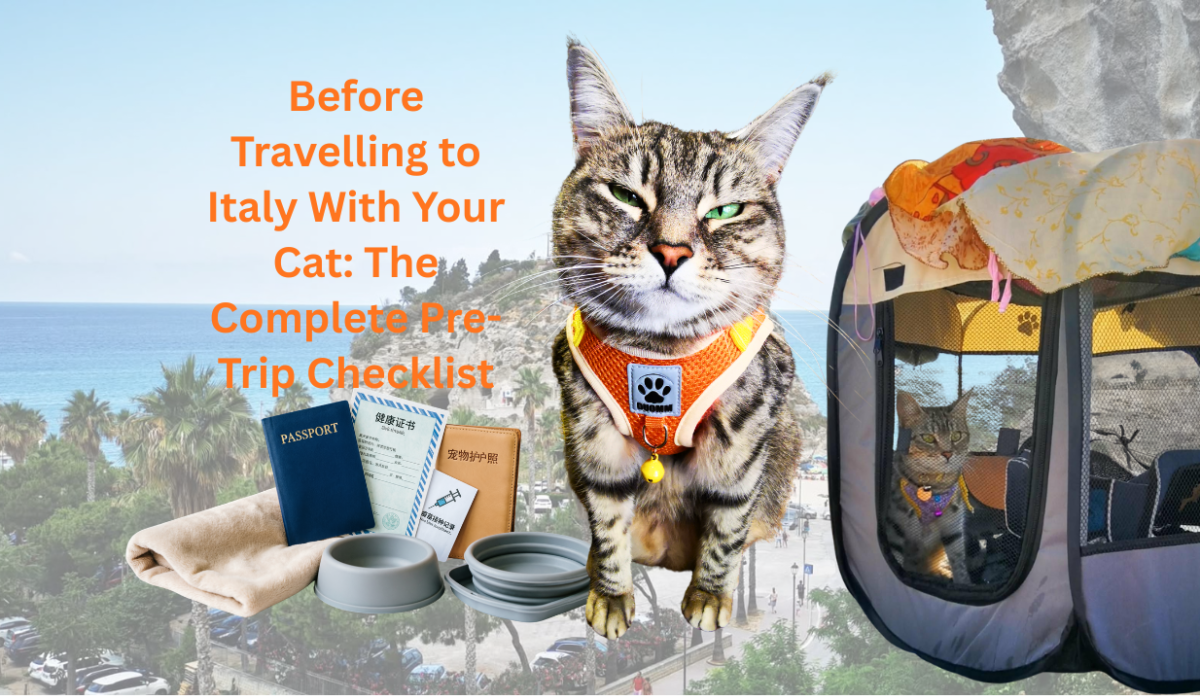
Before Travelling to Italy With Your Cat: The Complete Pre-Trip Checklist
Travelling with a cat doesn’t begin at the airport, the train station or the motorway.
It begins weeks — and sometimes months — before departure.
I’ve learned this the hard way.
When I first started travelling with Gigia, I made the mistake many people make. I planned the journey before I planned for the cat.
I researched trains, hotels and destinations. I booked the tickets. I packed the carrier. I made an itinerary.
And I assumed Gigia would simply adapt.
She did not.
She tolerated it, yes.
But tolerance isn’t the same as comfort.
And comfort isn’t the same as confidence.
After hundreds of journeys across Italy, I’ve developed a completely different approach.
A successful trip isn’t about making your cat endure travel. It’s about preparing them so travel becomes familiar — so the carrier, the journey, the new surroundings and even the rituals of departure gradually become things they recognise.
The goal isn’t to eliminate every unfamiliar experience.
It’s to give your cat enough familiar experiences that the unfamiliar no longer feels overwhelming.
This guide is about everything that happens before the journey: understanding your cat, deciding whether travel is appropriate, preparing the carrier, practising the actual journey, organising documents, preparing your accommodation, building an emergency plan and knowing when to change the plan.
Because the journey doesn’t start when you leave home.
It starts when you begin preparing.
Is Your Cat Ready to Travel?
Before you buy a ticket, book a hotel or build an itinerary, start with the most important question:
What kind of traveller is your cat?
Not every cat experiences unfamiliar environments in the same way.
Some cats are naturally curious. They investigate new rooms, watch strangers with interest and recover quickly from unfamiliar experiences.
Others are cautious. They need time to assess a new environment before deciding that it is safe.
Some cats are perfectly happy travelling in a carrier but have no interest whatsoever in walking around unfamiliar places.
And some cats simply don’t enjoy travelling.
That’s okay too.
The goal isn’t to force your cat to enjoy something because you enjoy travelling.
Questions to Ask Yourself
- Personality: Is your cat naturally curious or cautious?
- Confidence: How do they react to unfamiliar sounds, people and environments?
- Reaction to strangers: Do they hide or investigate?
- Carrier tolerance: Do they enter voluntarily or resist?
- Harness tolerance: Are they comfortable wearing one?
- Previous travel: Have they had positive or negative experiences?
- Ability to settle: Can they relax somewhere unfamiliar?
- Recovery: After something stressful, how quickly do they return to normal behaviour?
Four Useful Ways of Thinking About Traveller Types
These aren’t scientific categories. They’re simply useful ways of thinking about your cat’s individual temperament.
🐾 The natural traveller — Curious, adaptable and quick to settle. Travel may come relatively naturally.
🐾 The cautious explorer — Needs time to assess new surroundings but becomes confident once they feel safe. Patience is essential.
🐾 The carrier traveller — Feels safest inside the carrier and may prefer observing the world from there. There is nothing wrong with that.
🐾 The cat who really doesn’t enjoy travel — Some cats will always find travelling stressful. For them, staying somewhere familiar may be the kinder choice.
For more on Gigia’s transformation from reluctant traveller to confident explorer, see Gigia and Me! An Extraordinary Journey (Italian edition: Il Dono di Gigia).
Start Preparing Before You Book
One of the biggest mistakes I made with Gigia was treating preparation as something that happened after the journey had already been planned.
Now I work backwards from the cat.
Before booking anything, think about the experience you are asking your cat to have.
- How long will the journey take?
- How much time will your cat spend in the carrier?
- Will there be crowds, noise or unfamiliar people?
- Will your cat need to change trains or transport?
- Will you need to use a harness?
- What will happen when you arrive?
- How easily will your cat be able to retreat somewhere quiet?
This doesn’t mean you need to predict everything.
It means you should identify the parts of the journey that might be difficult for your particular cat before you commit to them.
Your Pre-Trip Preparation Timeline
You don’t need to do everything at once.
In fact, one of the biggest advantages of starting early is that you don’t have to.
Before booking:
Assess your cat and design the trip around their needs.
About one month before:
Begin carrier, harness and journey preparation.
Two to three weeks before:
Practise the actual mode of transport and refine your equipment.
One week before:
Confirm documents, bookings, accommodation, weather and emergency arrangements.
Day before:
Check everything, then stop changing things.
Departure morning:
Keep the routine as familiar and calm as possible.
Arrival:
Give your cat time to settle before expecting them to explore.
The exact timing will depend on your destination, your cat and your starting point.
The principle is simple:
Introduce change gradually rather than asking your cat to cope with everything on the same day.
1. Make the Carrier Familiar
The carrier should not make its first appearance on departure morning.
If the carrier only appears when your cat is going to the vet or leaving home, your cat can quickly learn what it predicts.
Carrier = something unpleasant is about to happen.
Instead, make the carrier part of everyday life.
- Leave it open at home.
- Put familiar bedding inside.
- Let your cat investigate it voluntarily.
- Put treats inside.
- Feed occasional meals inside.
- Allow your cat to sleep in it.
- Gradually practise closing the door for short periods.
- Carry your cat around the house.
- Then take very short journeys.
The objective is not simply to make your cat tolerate the carrier.
The objective is to make it familiar enough that it becomes somewhere your cat can settle.
Gigia’s Rule
The carrier isn’t luggage. It’s her portable bedroom.
Once your cat is comfortable with the carrier, you can think more carefully about the equipment you actually need. For practical equipment recommendations, see our Best Cat Travel Gear guide.
2. Introduce the Harness Gradually
If you intend to walk your cat in Italy, don’t wait until you arrive.
Harness training should happen gradually in familiar surroundings.
Start indoors.
Let your cat investigate the harness without putting it on.
Then introduce it for very short periods.
Reward calm behaviour.
Gradually increase the time.
Introduce the lead.
Walk around the house.
Then move into a quiet outdoor environment, if your cat is comfortable doing so.
Gradually introduce more stimulation.
The important thing is not speed.
Confidence can’t be forced. It can only be built through repeated positive experiences.
The Harness That Saved Gigia
For me, harness training isn’t theoretical.
In Chioggia, Gigia once slipped into the lagoon from Ponte Vigo.
Because her harness remained secure, I was able to retrieve her immediately.
I still think about what could have happened if the harness had failed — or if she hadn’t been wearing one.
That experience changed the way I think about harnesses.
They aren’t simply walking equipment.
They’re safety equipment.
3. Train for the Journey You Are Actually Taking
Don’t train your cat for some abstract concept called “travel.”
Train them for the actual experience they’re going to have.
If You’re Flying
Practise:
- Spending longer periods in the carrier
- Waiting calmly inside the carrier
- Being surrounded by unfamiliar sounds
- Being handled while remaining secure
- Staying calm around strangers
- Remaining settled for longer periods
For the practical realities of flying, see our Flying to Italy with a Cat guide.
If You’re Travelling by Train
Practise:
- Longer periods in the carrier
- Short train journeys
- Visiting a station without actually travelling
- Waiting in public spaces
- Lifts and other environments your cat may encounter
For the detailed transport information, see Train Travel with a Cat in Italy .
If You’re Travelling by Car
Practise:
- Sitting in the stationary car
- Hearing the engine start
- Very short drives
- Gradually longer journeys
- Getting used to planned stops
For the complete practical guide, see How to Travel with a Cat by Car .
4. Take a Practice Journey
Before the real journey, create a miniature version of it.
It might look like:
Home → carrier → car or train → short journey → unfamiliar place → return home.
Then gradually make the experience longer or more complicated.
But don’t judge success simply by whether your cat “made it through.”
Watch what happens afterwards.
- Does your cat settle quickly?
- Do they eat normally?
- Do they vocalise throughout the journey?
- Do they recover quickly?
- Are they curious about the new environment?
- Do they hide?
- How long do they need to decompress?
These observations are valuable.
Every practice journey teaches you something about your cat.
Maybe the carrier needs more work.
Maybe the journey needs to be shorter.
Maybe your cat prefers travelling by train rather than car.
Maybe they love the journey but need an hour to settle afterwards.
That’s information — not failure.
5. Prepare the Journey’s Practical Essentials
You don’t need to buy every gadget marketed to travelling pet owners.
You need the things that make your cat safe, comfortable and recognisably at home.
Essential Travel Kit
- ☐ Carrier
- ☐ Harness and lead, if appropriate
- ☐ Food
- ☐ Water
- ☐ Collapsible bowl
- ☐ Familiar blanket or bedding
- ☐ Litter supplies
- ☐ Waste bags
- ☐ Cleaning supplies
- ☐ Pet passport / required travel documents
- ☐ Emergency contact information
Useful Extras
- ☐ Cooling mat, when appropriate
- ☐ Spare carrier liner
- ☐ Absorbent pads
- ☐ Portable litter tray
- ☐ Familiar toy
- ☐ Small towel
- ☐ Wet wipes
- ☐ Backup food
- ☐ Bottled water
The familiar blanket may matter more to your cat than the expensive gadget.
I’ve learned that the hard way.
Scent, familiarity and routine are often more valuable than equipment.
For detailed equipment recommendations, see our Best Cat Travel Gear guide.
6. Prepare for Arrival Before You Leave
People spend enormous amounts of time planning how to get to Italy and surprisingly little time thinking about what happens when they arrive.
For a cat, arrival can be the most unsettling part of the journey.
Before booking accommodation, confirm:
- The accommodation genuinely accepts cats
- Pet fees and conditions
- Whether cats can be left alone
- Whether windows can be secured
- Whether balconies are safe
- Whether there are potential escape routes
- Whether the room can be kept quiet
- Where you can place the litter tray
- Whether there are resident dogs or other animals
Don’t rely solely on a booking site’s “pet-friendly” filter.
Ask.
A hotel that welcomes dogs may have very different rules for cats.
For help finding suitable accommodation, see our guides to finding cat-friendly accommodation in Italy and Cat-Friendly Hotels in Italy .
Arrival Day Is Not Sightseeing Day
When you arrive:
1. Enter calmly.
Don’t immediately open doors and begin unpacking around your cat.
2. Secure the room.
Check windows, doors, balconies, gaps and potential escape routes.
3. Set up water.
Fresh water should be available immediately.
4. Set up the litter tray.
Choose a quiet, accessible location.
5. Put out familiar bedding.
The smell of home matters.
6. Offer food.
Don’t force it. Simply make familiar food available.
7. Let your cat explore.
Allow them to investigate at their own pace.
8. Let them rest.
You may be excited to explore Italy.
Your cat may be exhausted.
Give them time.
7. Organise Health, Documents and an Emergency Plan
Travel Documents
Before travelling to Italy, check the requirements that apply specifically to your country of departure. Requirements differ depending on whether you are travelling within the EU or entering the EU from a non-EU country.
For cats entering Italy, the requirements can include:
- Microchip: Your cat must be identified by an ISO-compliant microchip where required.
- Rabies vaccination: Your cat must have a valid rabies vaccination meeting the applicable entry requirements.
- EU Pet Passport: Travellers moving between EU countries generally need a valid EU Pet Passport.
- Animal Health Certificate: Travellers arriving from outside the EU may require an official EU animal health certificate and additional entry documentation.
- Entry conditions: Additional rules can apply depending on the country of departure and the circumstances of the journey.
Check the Italian Ministry of Health’s official pet travel information and the European Commission’s pet travel information before departure.
Find a Vet Before You Need One
You don’t want to be searching Google at 11pm with a sick cat in an unfamiliar Italian town.
Before departure, save:
- A local veterinary practice
- An emergency veterinary clinic
- The address of each
- Telephone numbers
- Directions from your accommodation
- Your cat’s medical information
- Medication instructions, if applicable
Build a Plan B
You don’t need to predict every possible disaster.
You simply need a Plan B.
What happens if your cat escapes?
What if the carrier breaks?
What if your train or flight is delayed?
What if your accommodation suddenly becomes unavailable?
What if your cat becomes overwhelmed?
What if extreme weather changes your plans?
Know which journey you could shorten, which accommodation you could move to, which transport alternative exists and where you could safely spend an unexpected night.
Flexibility is one of the greatest advantages of travelling with a cat.
8. Check the Weather and Transport Rules
Preparation doesn’t stop once you’ve arrived in Italy.
Before setting out each morning, check:
- Temperature
- Heat warnings
- Thunderstorms
- Extreme weather
- Transport disruptions
- Local conditions at your destination
And be willing to change the plan.
A beautiful Italian itinerary on paper is worthless if the conditions make it unsafe or miserable for your cat.
For detailed summer advice, see Travelling with a Cat in Italy in Summer .
Verify the Current Transport Rules
Transport rules can change, and different operators have different requirements.
Don’t assume that because your cat was accepted on one train, airline or ferry, the same conditions automatically apply to the next journey.
Check the current rules for the specific operator, route and type of transport immediately before departure.
For example, Trenitalia publishes specific rules concerning pets, carriers, dimensions and tickets. Check Trenitalia’s official pet travel page for current information.
For more detailed preparation, see our Train Travel with a Cat in Italy , Flying to Italy with a Cat and How to Travel with a Cat by Car .
9. Your Final Week Before Departure
By this point, the preparation should be mostly familiar.
Don’t introduce unnecessary changes.
Instead, check that everything you’ve already practised is working.
One Week Before
- ☐ Confirm transport bookings
- ☐ Confirm accommodation
- ☐ Recheck pet policies
- ☐ Check current travel documentation requirements
- ☐ Confirm vaccination and identification records
- ☐ Check the weather forecast
- ☐ Confirm local vet information
- ☐ Check carrier and harness condition
- ☐ Make sure you have enough food and litter
- ☐ Review your emergency plan
This is not the time to discover that the carrier zip is broken.
10. The Day Before: Stop Preparing
The day before should be deliberately boring.
That’s a good thing.
Your Final Checklist
- ☐ Documents — passport, health certificate and vaccination records, as applicable
- ☐ Carrier — clean, secure and familiar
- ☐ Harness and lead — tested and accessible, if appropriate
- ☐ Food — enough for the journey, plus extra
- ☐ Water — fresh and packed with a travel bowl
- ☐ Litter — portable litter and tray
- ☐ Medication — if applicable, with instructions
- ☐ Familiar blanket — for comfort and scent
- ☐ Cleaning supplies — wipes, paper towels and bags
- ☐ Emergency contacts — vet, accommodation and transport
- ☐ Accommodation details — address, check-in time and pet policy
- ☐ Transport details — tickets and booking information
- ☐ Weather — final check
- ☐ Backup plan — what happens if something changes
Then stop.
You don’t need to spend the evening worrying about everything that could possibly go wrong.
You’ve prepared.
11. Departure Morning: Keep Everything Familiar
This is not the morning to experiment.
Don’t suddenly change your cat’s food.
Don’t introduce new equipment.
Don’t create unnecessary excitement.
Keep the normal routine as much as possible.
Breakfast at the usual time.
The same familiar blanket.
The same carrier.
The same calm voice.
The less dramatic departure feels to your cat, the better.
What I Actually Do With Gigia
This is what all those principles look like when I apply them to one real cat.
The Night Before
Gigia’s familiar blanket goes into the carrier.
Her food and water are prepared.
The carrier remains open in the living room so she can investigate it and settle naturally.
Nothing is introduced at the last minute.
Departure Morning
Her routine remains as normal as possible.
Breakfast at the usual time.
No unnecessary fuss.
No dramatic goodbye.
The carrier is already familiar, so it doesn’t suddenly appear as a warning that something frightening is about to happen.
The Harness
For short journeys, she wears her harness throughout the journey where appropriate.
For longer journeys, it is fitted before any door is opened.
That distinction matters.
An unfamiliar environment is exactly where you don’t want to be trying to put a harness on an anxious cat.
In the Carrier
She settles surprisingly quickly.
The blanket smells familiar.
The carrier is familiar.
The routine is familiar.
She knows what’s happening.
At Rest Stops
Water is offered regularly.
On longer journeys, she may have a short walk on the lead — but only somewhere genuinely safe and quiet.
I never assume that because she’s travelling well she wants to keep going.
Arrival
The first thing we do is recreate her familiar space.
Litter tray.
Water.
Food.
Blanket.
Carrier.
Then she explores.
What Gigia Has Taught Me
Some things I once thought mattered turned out not to matter much at all.
Expensive equipment.
Elaborate routines.
Trying to make every journey perfect.
Other things I underestimated turned out to matter enormously.
Familiar scent.
Repetition.
Not rushing.
Giving her control over how quickly she explores.
And perhaps the most important lesson of all:
Confidence cannot be forced. It can only be built.
For the full story of how Gigia became a confident traveller, read Gigia and Me! An Extraordinary Journey (Italian edition: Il Dono di Gigia).
Your Final Pre-Trip Checklist
If you want the short version, save this section.
- ☐ I understand my cat’s temperament and travel limits
- ☐ I have considered whether this journey is appropriate for my cat
- ☐ I have checked the entry requirements for my specific journey
- ☐ My cat’s identification and vaccination records are current
- ☐ I have the required travel documents
- ☐ My cat is comfortable with the carrier
- ☐ My cat is comfortable with the harness, if we will use one
- ☐ We have practised the actual mode of transport
- ☐ I have tested the journey before departure where possible
- ☐ I have checked the transport operator’s current pet rules
- ☐ I have confirmed the accommodation accepts cats
- ☐ I have checked windows, balconies and escape risks
- ☐ I have packed familiar food, bedding and litter
- ☐ I have a local vet and emergency veterinary contact
- ☐ I have a Plan B for delays or unexpected changes
- ☐ I have checked the weather
- ☐ I have not introduced unnecessary changes immediately before departure
- ☐ My cat’s first priority on arrival will be settling, not sightseeing
Travelling with a cat isn’t about proving that cats can travel.
It’s about discovering what travel can look like when you stop treating a cat like a small dog — and start paying attention to the individual animal beside you.
Prepare carefully.
Travel slowly.
Watch your cat.
And be prepared to change the plan when your cat tells you that the plan isn’t working.
That’s not a failed journey.
That’s travelling together.
Continue Planning Your Trip With Your Cat
Once your cat is prepared, these specialist guides can help you plan the journey itself: