
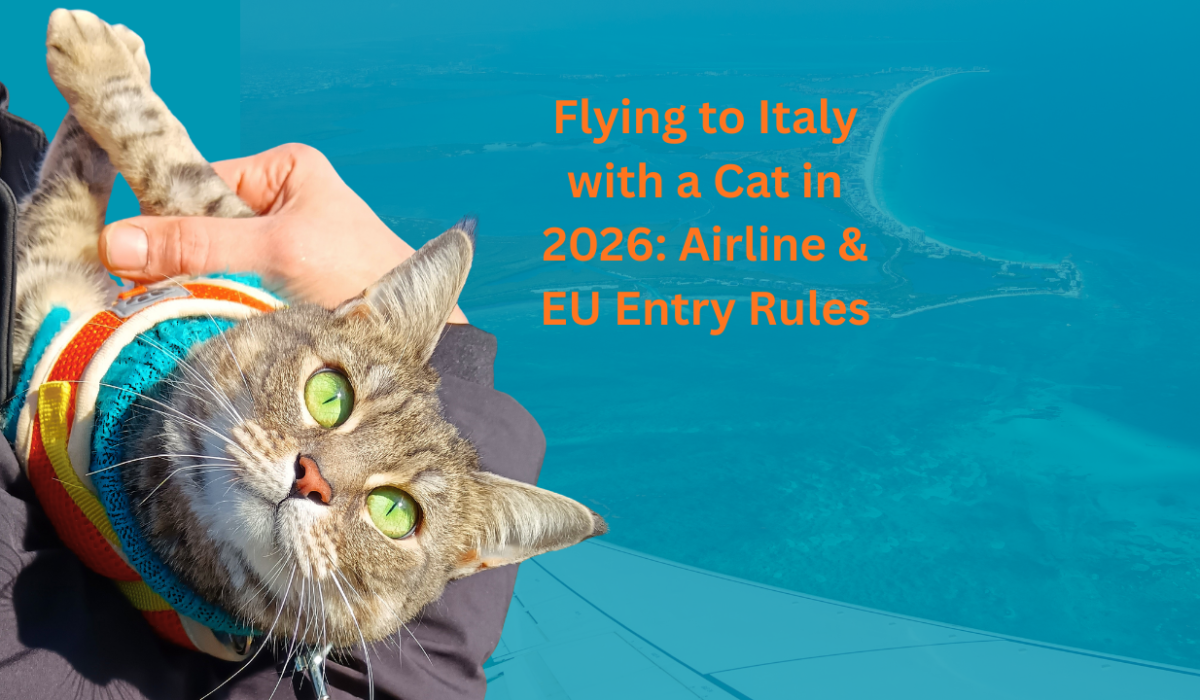
Flying to Italy with a Cat in 2026: Airline & EU Entry Rules
Flying to Italy with a cat in 2026 is absolutely possible. But unlike an ordinary holiday flight, travelling with a cat involves two separate sets of rules:
- the airline’s own rules for transporting cats in the cabin; and
- the European Union’s animal-health and entry requirements.
They are not the same thing.
Your airline may accept your cat in the cabin, but that does not automatically mean your cat meets Italy’s entry requirements. Equally, having the correct EU paperwork does not guarantee that an airline will accept your particular carrier, weight or pet booking.
This guide focuses specifically on flying to Italy with a cat: EU entry requirements, rabies and microchip rules, health certificates, airline cabin policies, carrier requirements, airport procedures, connecting flights and the practical preparation that can make the journey easier for both of you.
For the broader question of how to plan a holiday around your cat once you arrive, see our Ultimate Guide to Travelling Italy with Your Cat.
1. Before You Book Your Flight: Check Your Cat’s Eligibility
The first mistake to avoid is booking the flight and worrying about the paperwork afterwards.
Start with your cat.
For non-commercial travel, cats entering Italy must meet the applicable EU animal-health requirements. These include identification, rabies vaccination and the appropriate identification document.
The exact requirements depend on where your cat is travelling from.
A cat travelling from another EU country is not in exactly the same position as a cat arriving from the United Kingdom, the United States or another non-EU country.
Before booking, establish:
- Which country your cat is travelling from
- Whether that country is inside or outside the EU
- Whether your cat has a compliant microchip
- Whether the rabies vaccination is valid
- Whether the first rabies vaccination has completed its required waiting period
- Whether you need an EU Pet Passport or an EU Animal Health Certificate
- Whether a rabies antibody titration test is required for your country of departure
- Which designated travellers’ point of entry you will use if entering from outside the EU
Do this before paying for a non-refundable flight.
2. Microchip Requirements
Your cat must be properly identified before travelling.
For EU pet travel, identification is generally provided by a compliant microchip. The microchip number must correspond with the identification information recorded in the relevant pet passport or health certificate.
If your cat’s microchip was implanted after the rabies vaccination, ask your veterinarian whether the vaccination needs to be repeated.
Do not assume that because your cat has a microchip, everything is automatically compliant. Have your vet check the chip and documentation before travelling.
For current EU requirements, consult the European Commission’s official pet travel guidance.
3. Rabies Vaccination: The 21-Day Rule
Rabies vaccination is one of the most important parts of preparing your cat for international travel.
For a primary rabies vaccination, the EU requires a waiting period before the animal can travel.
- The cat must be old enough to receive the primary vaccination under the applicable rules.
- The vaccination must be administered after identification by microchip.
- After the primary vaccination, at least 21 days must normally pass before travel.
Booster vaccinations are different. If the previous rabies vaccination has remained continuously valid, the animal generally does not have to restart the 21-day waiting period.
But if a booster is given after the previous vaccination has expired, it may be treated as a new primary vaccination.
The European Commission’s pet travel guidance explains the current vaccination requirements.
4. EU Pet Passport or EU Animal Health Certificate?
This depends largely on where you are travelling from.
Travelling from another EU country
When travelling within the EU, cats normally travel with a valid EU Pet Passport containing the required identification and rabies information.
The passport must remain valid and the rabies vaccination must be in date.
Travelling from a non-EU country
If your cat is arriving in the EU from a non-EU country, an EU Animal Health Certificate may be required.
The certificate must contain the relevant identification, health and vaccination information and must be issued within the required timeframe before the animal reaches the EU travellers’ point of entry.
Under the current EU framework, the animal health certificate is generally valid for 10 days from its issue by the official veterinarian until the documentary and identity checks at the travellers’ point of entry.
After entry, the certificate can have a longer period of validity for onward movement within the EU, subject to the applicable rules and the validity of the rabies vaccination.
The European Commission’s guidance for bringing a pet into the EU from a non-EU country is the best place to check the current requirements.
5. Some Countries Require Additional Rabies Testing
This is where international pet travel can become considerably more complicated.
Depending on the country your cat is travelling from, an additional rabies antibody titration test may be required before entering the EU.
Where applicable, this can add several months to the preparation process because the blood test has to be performed according to the applicable EU requirements and a waiting period may apply.
This is one reason I recommend starting the process early rather than treating pet travel paperwork as something you can organise a few days before departure.
The Italian Ministry of Health’s guidance for travelling to Italy with pets provides country-specific information and should be checked alongside the European Commission’s current rules.
6. The Five-Pet Rule
For ordinary non-commercial pet travel, EU rules generally allow a maximum of five dogs, cats or ferrets to travel with their owner or authorised person.
There are specific exceptions for animals travelling for competitions, exhibitions or sporting events, subject to additional conditions.
If you are travelling with more than five animals, do not assume that the normal holiday-pet rules apply.
7. Your Airline Has a Completely Separate Set of Rules
This is where many otherwise well-prepared travellers get caught out.
Meeting Italy’s entry requirements does not mean your airline must accept your cat.
Airlines can set their own rules covering:
- Whether cats are accepted in the cabin
- Maximum combined weight of cat and carrier
- Maximum carrier dimensions
- Carrier construction
- Whether the carrier must fit completely under the seat
- Number of animals permitted on each flight
- Advance booking requirements
- Whether pets are permitted on particular aircraft or routes
- Whether pets are accepted on codeshare or partner-operated flights
8. ITA Airways: An Important 2026 Example
ITA Airways is particularly relevant for travellers flying to Italy because its pet rules have changed in recent years.
According to ITA Airways’ current guidance, cats and dogs can travel in the cabin subject to the airline’s conditions.
For international flights, the standard cabin limit is currently 8 kg including the carrier and food. On domestic Italian flights, ITA Airways currently permits a higher combined weight limit of up to 12 kg including the carrier and food, subject to the applicable service and flight conditions.
The carrier must be soft, properly ventilated, secure and suitable for the animal, and the cat must remain inside it during the flight.
ITA Airways also requires the appropriate pet-transport documentation and booking procedure.
Because airline policies can change, check the ITA Airways official Pets in the Cabin page for the exact rules applying to your flight.
9. Lufthansa: Another Common Route to Italy
Lufthansa is another important option for travellers connecting to Italy through its European network.
Lufthansa currently permits small dogs and cats in the passenger cabin subject to availability and specific conditions.
The combined weight of the animal and carrier must not exceed 8 kg, and the maximum carrier dimensions are currently 55 × 40 × 23 cm.
The carrier must be soft-sided, secure, leak-proof and suitable for your cat to remain in a comfortable position.
Lufthansa also requires advance registration and confirmation of the pet booking. Its current guidance states that cabin-pet bookings should be made no later than 72 hours before departure.
Check the Lufthansa official cabin-pet registration page before booking.
10. Your Flight May Have More Than One Airline Involved
Be particularly careful with connecting flights and codeshare bookings.
You may buy one itinerary from one airline while one or more sectors are operated by another airline.
That can matter because the operating airline’s aircraft, cabin configuration and pet policy may determine whether your cat can travel.
Before paying for the ticket, check:
- Which airline operates every sector
- Whether your cat is accepted on every sector
- Whether the same carrier dimensions apply throughout the journey
- Whether the pet booking must be made separately for each operating airline
- Whether the connection requires you to collect and re-check baggage
- Whether you will have to pass through immigration or security during the connection
A flight that looks simple on a booking website can become much more complicated once a pet is involved.
11. The Carrier Is Part of Your Cat’s Ticket
When travelling by air, the carrier is not simply luggage.
It is the environment in which your cat may spend several hours.
Airlines commonly require a soft-sided carrier that can be safely stowed under the seat in front of you.
Depending on the airline, the carrier may need to be:
- Soft-sided
- Leak-proof
- Securely closed
- Well ventilated
- Small enough to fit under the seat
- Large enough for your cat to remain in a comfortable position
Do not buy the carrier first and then search for an airline that accepts it.
Choose the airline first. Check its exact carrier dimensions. Then buy and train with the carrier.
For practical carrier and travel-equipment recommendations, see our Best Cat Travel Gear guide.
12. Book Your Cat’s Place on the Flight
Buying your own plane ticket is not the same as booking your cat.
Many airlines limit the number of animals permitted in the cabin, so you should request the pet service as early as possible.
Ideally:
- Choose your route.
- Confirm that the airline accepts cats.
- Check the exact carrier and weight restrictions.
- Ask whether your particular flight has pet availability.
- Book the pet service.
- Obtain confirmation.
- Keep that confirmation with your travel documents.
13. What to Pack for a Flight to Italy With a Cat
Air travel is not the time to pack your entire house.
But you should have enough supplies to deal with delays, spills and unexpected changes.
- ☐ Airline-approved carrier
- ☐ Familiar blanket or bedding
- ☐ Absorbent pads
- ☐ Spare absorbent pad
- ☐ Small cleaning cloth or towel
- ☐ Waste bags
- ☐ Water
- ☐ Collapsible bowl
- ☐ Familiar food
- ☐ Required medication, if applicable
- ☐ Pet passport or animal health certificate
- ☐ Vaccination records
- ☐ Microchip information
- ☐ Airline pet-booking confirmation
- ☐ Accommodation details
- ☐ Emergency veterinary information
Keep both digital and physical copies of important documents.
And keep the originals somewhere secure rather than buried at the bottom of your suitcase.
14. Should You Feed Your Cat Before Flying?
There is no single feeding schedule that is appropriate for every cat.
Some cats travel comfortably after eating normally. Others experience nausea or stress when travelling.
The important thing is not to experiment for the first time on flight day.
Discuss feeding and hydration with your veterinarian, particularly if your cat has previously experienced motion sickness, vomiting, anxiety or other travel-related problems.
During long journeys, small amounts of water may be appropriate, but you should follow your veterinarian’s advice for your individual cat.
Do not make major changes to your cat’s diet immediately before an international journey.
15. Do Not Sedate Your Cat Without Veterinary Advice
Air travel can make cats anxious, and it is understandable that owners sometimes consider medication.
But sedating a cat for air travel is not something to improvise.
Medication can affect an animal’s balance, behaviour, breathing and ability to respond normally to stress. Some airlines may also have their own restrictions regarding sedated animals.
If you believe your cat may need medication for travel, speak to your veterinarian well before departure.
A better long-term approach is often gradual preparation: carrier training, short journeys and repeated positive experiences.
This is exactly the philosophy behind our broader Pre-Trip Checklist for Travelling with a Cat.
16. Arriving in Italy
Once the aircraft lands, your responsibilities do not necessarily end.
If you are entering Italy from outside the EU, your cat may need to pass through the designated travellers’ point of entry and undergo documentary and identity checks.
The relevant authorities can check:
- Your cat’s identification
- Microchip information
- Rabies vaccination
- Pet passport or animal health certificate
- Any additional documentation required for the country of departure
For non-EU arrivals, check the designated entry arrangements for the Italian airport you are using.
The Italian Ministry of Health’s official guidance for travelling to Italy should be checked before departure.
17. If Italy Is Not Your First EU Stop
This is an important point for travellers connecting through another European country.
If you are travelling from outside the EU and your itinerary first enters the EU in another member state, the relevant documentary and identity checks generally take place at the first EU point of entry.
For example, if your journey is:
United States → Frankfurt → Italy
Germany may be the point at which your cat enters the EU, rather than Italy.
That means you should not plan your documentation around the assumption that the Italian airport will be the first place your paperwork is checked.
Always verify the arrangements for your actual route and first EU airport.
18. Layovers: Keep Your Cat’s World Small
Airports are overwhelming environments for many cats.
During a connection, resist the temptation to remove your cat from the carrier simply because you have a long wait.
Unless you are in a genuinely secure and appropriate location, opening the carrier creates an unnecessary escape risk.
Instead:
- Keep the carrier securely closed in busy public areas.
- Offer water when appropriate.
- Monitor your cat’s behaviour.
- Locate the correct departure gate early.
- Allow quiet time whenever possible.
- Follow airport and airline instructions regarding pets.
If your itinerary involves a long layover, check the airport’s current facilities rather than assuming that a pet-relief area will be available for cats.
19. Your First Night in Italy
After a long flight, your cat may not want to see Italy.
She may want to sleep.
This is where your broader travel preparation becomes important.
Before opening the carrier, make sure the room is secure:
- Check windows.
- Check balconies.
- Check doors.
- Look for gaps or escape routes.
- Set up water.
- Prepare the litter tray.
- Put out familiar bedding.
- Offer familiar food.
Let your cat decide how quickly she explores.
The first evening does not need to be a sightseeing opportunity.
For help choosing somewhere genuinely suitable for cats, see How to Find Cat-Friendly Accommodation in Italy.
20. What I Learned Flying and Travelling With Gigia
When I first began travelling with Gigia, I thought the difficult part would be the journey itself.
It wasn’t.
The difficult part was learning to see the journey from her point of view.
The carrier was unfamiliar.
The sounds were unfamiliar.
The people were unfamiliar.
The smells were unfamiliar.
And every time I changed something without giving her time to understand it, I was asking her to cope with another unknown.
Over time, I learned that preparation is not about controlling every part of the journey.
It is about making enough of the journey familiar that the unfamiliar parts become manageable.
The carrier becomes familiar.
The routine becomes familiar.
The sounds become familiar.
And eventually, the journey itself becomes something your cat recognises.
That is why I now think about preparation as training for familiarity, rather than simply preparing luggage and paperwork.
21. The Final Flying-to-Italy Checklist
- ☐ Confirm the country-specific EU entry requirements
- ☐ Check your cat’s microchip
- ☐ Confirm rabies vaccination is valid
- ☐ Check the 21-day waiting period if applicable
- ☐ Confirm whether a rabies antibody test is required
- ☐ Obtain the correct pet passport or animal health certificate
- ☐ Check the designated travellers’ point of entry if entering from outside the EU
- ☐ Choose an airline that accepts cats on your route
- ☐ Check the exact carrier dimensions
- ☐ Check the exact combined weight limit
- ☐ Confirm the pet is permitted on the actual operating flight
- ☐ Reserve the pet space
- ☐ Obtain confirmation of the pet booking
- ☐ Train your cat to use the carrier
- ☐ Prepare familiar bedding
- ☐ Pack water and appropriate food
- ☐ Pack absorbent pads and cleaning supplies
- ☐ Carry physical and digital copies of documents
- ☐ Check your connection and first EU entry point
- ☐ Confirm your accommodation accepts cats
- ☐ Save a local veterinary contact
- ☐ Check the rules again shortly before departure
Flying to Italy Is Only the Beginning
Getting your cat onto the aircraft is only the first part of the adventure.
Once you arrive, you still need to think about accommodation, trains, cars, weather, daily routines and how much stimulation your individual cat actually enjoys.
That is why I recommend treating the flight as one part of a much larger journey.
Start with the paperwork.
Choose the airline carefully.
Train the carrier.
Prepare for the airport.
And then, once you arrive, slow down enough to let your cat experience Italy in her own way.
Continue Planning Your Cat-Friendly Italy Adventure
Explore these guides to help you plan every stage of your journey:
For the most current legal requirements, always verify the rules with the European Commission and the Italian Ministry of Health before travelling.