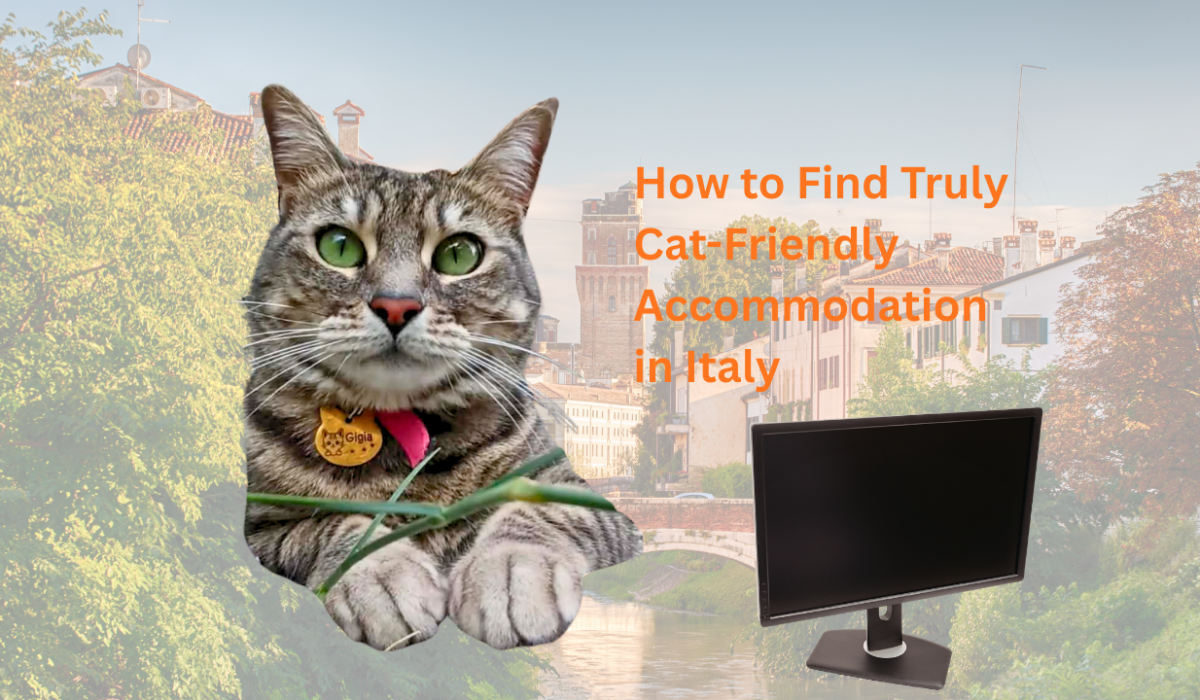
How to Find Truly Cat-Friendly Accommodation in Italy
Finding accommodation in Italy that accepts pets is easy.
Finding accommodation that is genuinely safe, quiet and suitable for a cat is something else entirely.
After travelling extensively with Gigia through Italian cities, villages, vineyards and countryside, we have learned that the words pet-friendly can tell you surprisingly little about what a stay will actually be like for a cat.
A property may accept dogs but have no experience with cats. A beautiful apartment may have an unsecured balcony. A rural farmhouse may have dogs roaming freely around the grounds. A highly rated hotel may sit directly above a busy bar.
So instead of asking simply, “Does this accommodation allow pets?”, we use a different approach.
This guide explains exactly how to find cat-friendly accommodation in Italy, how to evaluate listings, what questions to ask hosts, which red flags to avoid, and how to make the final booking decision based on your cat rather than on a generic “pets allowed” label.
The Gigia Method: Five Steps to Better Accommodation
After enough trips, we found that choosing accommodation became much easier when we stopped treating booking platforms as the final authority.
Instead, we use five simple stages:
Filter
Find properties that appear to accept cats or pets.
Vet
Read the listing carefully and look for feline-friendly details and warning signs.
Verify
Contact the host and confirm the details that matter for your cat.
Check
Investigate the neighbourhood, roads, noise and surroundings.
Book
Choose the property that best fits your cat, not simply the one with the highest rating.
This distinction is important because the accommodation itself is only one part of the environment your cat will experience.
Step 1: Use Booking Filters — But Don’t Trust Them
Booking platforms such as Booking.com and Airbnb are excellent places to begin your search.
Use their pet-friendly filters to create a shortlist, but treat the result as discovery rather than verification.
A “pets allowed” label may mean:
- dogs are accepted but cats are not;
- pets are accepted only in selected rooms;
- there is an additional pet fee;
- pets cannot enter certain areas;
- the host has to approve the animal in advance;
- the property has no particular understanding of feline needs.
The filter has done its job when it gives you possibilities to investigate. It has not done its job when you assume every result is automatically suitable for your cat.
For rural stays, you can also explore our dedicated Cat-Friendly Agriturismo in Italy guide.
Step 2: Read the Listing from a Cat’s Perspective
Once you have a shortlist, stop looking at the property only as a human traveller.
Ask yourself what the accommodation will look, sound and function like from your cat’s perspective.
🟢 Green Flags
- Self-contained apartment or suite
- Private entrance
- Quiet residential location
- Secure windows
- Enclosed or controlled outdoor space
- Clear pet conditions
- Separate sleeping or retreat areas
- Previous reviews mentioning cats
🔴 Red Flags
- Unsecured balconies
- Open staircases or obvious escape routes
- Heavy shared hallway traffic
- Descriptions focused entirely on dogs
- Vague “pets welcome” wording
- No information about windows or balconies
- Free-roaming resident dogs
- Accommodation directly beside a busy road
Photographs can also reveal more than the written description.
Look closely at balconies, terraces, windows, doors, staircases and entrances. Ask yourself where your cat would hide if she became overwhelmed and how easily she could reach an exit.
Step 3: Message the Host Before You Book
This is one of the most valuable steps in the entire process.
If a listing says “pets allowed”, do not assume that this automatically means cats are specifically welcome.
Send the host a short, direct message before confirming the reservation.
Questions to Ask
- Do you specifically accept cats?
- Are there additional charges for a cat?
- Are the windows secure?
- Is the balcony or terrace enclosed?
- Are there resident dogs, cats or other animals?
- Does the accommodation have a private entrance?
- Are there shared areas where pets have to pass through?
- Is the property close to a busy road?
You can keep the initial message simple:
“Hello, we are travelling with a calm indoor cat. Are cats specifically welcome at your property? Could you also tell us whether the windows and balcony are secure, and whether there are resident animals on the property?”
The host’s response is useful information in itself.
A thoughtful answer that addresses your questions specifically can give you confidence.
A vague response such as “Don’t worry, pets are fine” tells you much less.
If the host seems uncomfortable with cats, cannot answer basic safety questions or gives contradictory information, there is no reason to force the booking.
Step 4: Check the Pet Policy and the Real Cost
Before booking, make sure you understand exactly what the accommodation’s pet policy means financially and practically.
You may encounter:
- a nightly pet fee;
- a fixed fee for the entire stay;
- a cleaning charge;
- a refundable deposit;
- restrictions on where the cat can go;
- additional conditions for longer stays;
- or no additional charge at all.
Do not assume that the headline room rate is the final price for travelling with your cat.
Read the accommodation’s conditions carefully and, if anything is unclear, ask the host before confirming.
If affordability is particularly important, see our Budget-Friendly Pet Stays in Italy guide for another approach to finding lower-cost accommodation.
Step 5: Check the Location, Not Just the Room
Even the perfect apartment can be the wrong choice if its surroundings are unsuitable for your cat.
Before booking, open the property in a map application and look beyond the immediate building.
Check:
- nearby roads and traffic;
- restaurants, bars and nightlife;
- construction sites;
- railway lines;
- busy pedestrian areas;
- open countryside or wildlife areas;
- parks and places where you might safely walk with a harness;
- shops and practical services you may use during the stay.
This is particularly important because cats experience destinations differently from humans.
A lively central location may be fantastic for sightseeing but overwhelming for a nervous cat.
Conversely, a quiet residential neighbourhood may look less exciting on a booking platform while providing a much better environment for a feline traveller.
For travellers interested in slower and quieter Italian destinations, our Italian Hill Towns for Calmer Cat Travel guide explores this idea in more detail.
Accommodation Type Matters Too
There is no single accommodation type that works for every cat.
The right choice depends on your cat’s personality, your itinerary and the level of control you want over the environment.
Hotels
A good hotel can be an excellent option for city travel, particularly when you want reception services, predictable access and a convenient location.
Look for quiet rooms, secure windows, limited corridor traffic and clear cat policies.
Our dedicated Where to Stay in Italy with a Cat guide explores the different hotel and accommodation options in greater detail.
Self-Catering Apartments
For many cats, an apartment can provide something a hotel room cannot: a more recognisable sense of territory.
A kitchen, separate living space and independent entrance can make longer stays easier and give your cat more opportunities to retreat.
But check balconies, windows and external doors carefully before booking.
Agriturismi
Agriturismi can be wonderful for cats who enjoy quieter surroundings, particularly when the accommodation is self-contained and the grounds are controlled.
However, rural does not automatically mean safe.
Open gardens, resident dogs, farm animals and nearby roads can introduce risks that are less obvious from photographs.
For a detailed rural-accommodation checklist, see our Cat-Friendly Agriturismo in Italy guide.
How to Choose Accommodation for Your Cat’s Personality
One of the biggest mistakes travellers make is choosing accommodation according to their own preferences rather than their cat’s.
Gigia is unusually comfortable with new environments. That does not mean every cat will respond in the same way.
Think about your own cat.
If Your Cat Is Nervous
- prioritise quiet streets;
- choose self-contained accommodation;
- avoid properties with heavy communal traffic;
- look for hiding spaces;
- consider staying several nights rather than moving constantly.
If Your Cat Is Curious and Active
- look for a larger interior space;
- consider safe enclosed terraces or courtyards;
- choose accommodation where controlled exploration is possible;
- make sure escape routes are still secure.
If Your Cat Travels Well but Dislikes Dogs
- ask about resident dogs;
- avoid properties where dogs roam communal areas;
- check whether pets share entrances or gardens;
- request a room or apartment away from other animals.
The objective is not to find the accommodation with the most pet amenities.
It is to find the environment in which your particular cat is most likely to be settled and secure.
Use Reviews as Evidence — Not Proof
Reviews can be extremely useful, but read them selectively.
Look for comments mentioning:
- cats;
- dogs;
- noise;
- balconies;
- windows;
- access to gardens;
- the behaviour of the hosts;
- cleanliness after pets;
- privacy and independence of the accommodation.
A review saying “perfect for our dog” is not necessarily evidence that a property is suitable for your cat.
Similarly, a review from a cat traveller can provide valuable information that the property’s official description never mentions.
When Should You Book Direct?
Once you have identified a promising property on Booking.com, Airbnb or another platform, check whether the owner operates an independent website.
Direct contact can sometimes make it easier to:
- ask detailed questions about cats;
- request a particular room or apartment;
- discuss a longer stay;
- understand the property’s pet policy;
- clarify practical details that are missing from the platform.
This can be particularly useful with small, family-run agriturismi, B&Bs and independent accommodation.
But booking direct is not automatically better.
Always consider the cancellation conditions, payment protection and clarity of the booking terms. The best booking channel is the one that gives you both confidence in the property and appropriate protection for the reservation.
Check the Destination Before You Commit
Accommodation should never be considered in isolation.
Once you have found a promising property, investigate the destination around it.
Where will you buy food?
Is there a veterinary clinic reasonably nearby?
Are there busy roads you would have to cross?
Is there somewhere appropriate for a quiet walk if your cat travels on a harness?
Will restaurants, cafés or attractions that you want to visit actually work with your cat?
Our Gigia Travel Cat Locations directory can help you explore destinations and experiences that Gigia has personally visited.
This is especially useful when planning around smaller Italian towns where general travel information may not tell you much about travelling with a cat.
The Final Pre-Booking Checklist
Before you press “Reserve”, run through this short checklist.
🐾 Cat-Friendly Accommodation Checklist
- ☐ Cats are specifically accepted
- ☐ Pet fees and conditions are clear
- ☐ Windows are secure
- ☐ Balcony or terrace is safe or can remain closed
- ☐ Exterior doors are manageable
- ☐ There are no obvious escape routes
- ☐ Resident animals are known
- ☐ The surrounding area suits your cat
- ☐ The accommodation provides a quiet retreat space
- ☐ The host has answered your questions clearly
If several answers are uncertain, do not let a beautiful photograph or excellent review score rush you into a booking.
The Gigia Method: Filter → Vet → Verify → Check → Book
After using this system a few times, choosing accommodation becomes much more straightforward.
- Filter: use booking-platform filters to find potential properties.
- Vet: examine the listing, photographs and reviews carefully.
- Verify: contact the host and confirm that cats are genuinely welcome.
- Check: investigate the neighbourhood, roads, noise and surrounding environment.
- Book: choose the property that best fits your cat and your journey.
And those details are worth checking.
Because the goal isn’t merely to find somewhere that lets you arrive with a cat.
The goal is to find somewhere where both of you can actually enjoy being there.
Continue Planning Your Cat-Friendly Trip Through Italy
Once you understand how to evaluate accommodation, the broader accommodation guide can help you compare different types of stays, regions and bases across Italy.
👉 Where to Stay in Italy with a Cat: The Complete Hotel & Booking Guide
For the wider journey, including transport, destinations and preparation:
👉 The Ultimate Guide to Travelling Italy with Your Cat
Every cat is different. What works for Gigia may not work for your cat. Use these ideas as a flexible guide and always prioritise your cat’s safety and wellbeing.