Cat-Friendly Things to Do in Italy: 15 Experiences to Enjoy with Your Cat
Cats don’t hurry. Gigia certainly never has.
Give a cat a choice between a crowded attraction and a quiet piazza, and they will almost always choose the piazza.
It’s not complicated.
After years of travelling around Italy with a cat—by car, by train, and occasionally on foot when she decides the harness means “stop and stare at everything”—I’ve learned something surprising.
Italy may be one of the best countries in Europe for travelling with a cat.
Not because Italy is especially pet-friendly in the way some northern European countries are. Not because cats are everywhere (though they are). And not because Italian law guarantees cat access to every public space.
No.
Italy works for cats because the way Italy is experienced naturally suits the way cats travel.
Slowly. Locally. Attentively. With frequent stops for observation, rest and the simple pleasure of being somewhere interesting.
This isn’t a guide to 25 conventional “attractions.”
Some of the best experiences here are wonderfully ordinary: sitting together in a village piazza, watching the world go by. That is precisely what makes this perspective different from a standard Italian travel guide.
Why Italy Works So Well for Cat Travel
I’m not claiming Italy is statistically “the best” country for cats according to some objective measure. But after travelling extensively with Gigia across Italy—and hearing from readers who’ve done the same—Italy works exceptionally well for feline travellers for reasons that go beyond mere pet-friendliness.
Italy is unusually suited to slow travel. You don’t need to rush between destinations to have a worthwhile trip. The country rewards lingering, which is exactly what cats do naturally.
Compact geography. Very different landscapes and experiences—mountains, lakes, vineyards, coast, cities—are often within relatively short distances. You can experience extraordinary variety without subjecting your cat to marathon journeys.
Historic towns are compact and walkable. Much easier with a cat than sprawling modern cities. You can explore an entire medieval centre on foot in a couple of hours. For more on the quietest destinations, see our guide to the best Italian hill towns for calm travel.
Outdoor café culture. Cafés, piazzas and terraces make it possible to pause rather than constantly move. You can stop, sit down, let your cat observe and decide what comes next.
The countryside is exceptionally accessible. You can move from a major city into vineyards, hills, lakes or mountains relatively quickly. The urban-rural transition is rarely abrupt or ugly.
Slow travel feels natural in Italy. It fits the way a cat actually travels: stopping, observing, exploring and resting. You don’t need to fight the culture to travel slowly. The culture encourages it.
And perhaps most importantly:
Gigia has actually experienced it. I’m not theorising about whether Italy is cat-friendly. We’ve travelled extensively around the country together. She’s inspected Venetian canals, supervised Roman piazzas, judged Tuscan vineyards and approved Umbrian hill towns. With over 100 towns and villages visited and 11 million views of her adventures, this guide is built on lived experience, not theory.
Italy and cats share the same travel philosophy: slow down, explore locally, stop frequently, observe your surroundings and don’t try to see everything in one day.
There’s something almost contradictory about travelling with a cat in Italy. The narrow medieval streets were built for donkeys and pedestrians, not cats. The cobblestones can be uneven. The crowds in popular cities can be overwhelming.
And yet, somehow, it works.
The narrow streets create intimate, sheltered spaces that feel less overwhelming than broad modern boulevards. The cobblestones provide interesting textures and scents. The small villages are easy to navigate. The outdoor cafés offer natural resting points. The trains between major cities are less stressful than driving. The countryside is everywhere, offering an easy escape from urban noise. And the countless small towns mean you don’t have to build the entire trip around major attractions.
Gigia doesn’t travel like a human. She doesn’t want to “do” a city. She wants to sit somewhere interesting, watch people, investigate a doorway, smell a garden, walk a little, stop again and decide whether the next corner deserves further investigation.
Italy accommodates that beautifully.
What Actually Makes an Experience Cat-Friendly?
Before we explore the experiences themselves, let me explain what I mean by “cat-friendly.”
This isn’t simply about whether cats are technically allowed somewhere. A truly cat-friendly experience considers:
- Noise levels — loud crowds, traffic, amplified music
- Crowds — density of people, whether your cat can see what’s coming
- Temperature — shade, direct sun, reflected heat
- Access to water — can your cat drink when needed
- Safe walking surfaces — uneven cobbles, hot pavement, broken glass
- Traffic — cars, bicycles, scooters passing close by
- Dogs — especially off-leash dogs in public spaces
- Escape risks — open doors, unfenced areas, busy roads nearby
- Whether the cat can remain in a carrier when necessary
- Availability of quiet places to retreat
- Length of the experience — can your cat tolerate it
- Whether the experience actually benefits the cat or is primarily for the human
That last distinction matters. It’s the difference between dragging your cat somewhere because you want to see it and choosing experiences your cat can genuinely appreciate.
Gigia has taught me that the best experiences are often the ones where she can simply be present — observe, rest, explore a little, then rest again.
For more on this philosophy, see our expert cat travel tips.
A Simple Decision Framework
Before you choose any activity, consider where it falls:
🐾 Great for cats
- Quiet villages
- Gardens
- Countryside
- Calm piazzas
- Scenic walks
- Lakeside promenades
- Train journeys
- Outdoor cafés in quiet locations
🐾 Good with preparation
- Markets (go early)
- Busy historic centres (off-peak)
- Boats (calm days)
- Longer train journeys (pack properly)
🐾 Usually better for humans
- Very crowded attractions
- Noisy festivals
- Fireworks
- Packed beaches
- Large sporting events
- Amplified music
- Events with unpredictable crowds
Use this framework as a guide, not a rule. You know your cat better than anyone.
When an Italian Experience Isn’t Cat-Friendly
Knowing what to avoid is just as important as knowing what to seek out.
Some experiences are genuinely not suitable for cats, regardless of how well-behaved your feline companion might be:
- Major museums and archaeological sites with strict animal restrictions
- Crowded monuments where escape would be nearly impossible
- Beaches with seasonal pet restrictions (though many have designated areas)
- Churches where animals aren’t permitted (always check in advance)
- Events with fireworks or amplified music
- Very hot summer attractions with no shade or water access
- Places with open drops, unfenced balconies or dangerous traffic
That’s one of the most important lessons Gigia has taught me. Sometimes the kindest thing you can do for your cat is leave them in a comfortable, secure space while you visit something that simply isn’t suitable for them.
15 Cat-Friendly Experiences in Italy
Let’s explore the experiences themselves. Some are specific destinations. Others are broader categories. All are things Gigia has actually done.
1. Wandering Quiet Historic Towns
Italy has an extraordinary number of historic towns. Not cities — towns. Small, compact, walkable places where you can explore without constant crowds.
The experience is simple: arrive, park or step off the train, walk slowly through narrow streets, stop in a piazza, watch life unfold, walk a little more, stop again.
The walk follows her rhythm, not mine.
What Gigia thinks: She investigates doorways, sniffs corners, sits in sunbeams, watches people pass and decides whether each town deserves further exploration. Most do.
Examples: Asolo, Cison di Valmarino, Castelfranco Veneto, Bagnoregio, and the countless medieval towns and villages scattered across Italy’s hills and valleys.
For more ideas, see our 15 Best Day Trips from Treviso guide.
2. Sitting in a Village Piazza
This sounds almost too simple.
It isn’t.
Find a quiet piazza in a small town. Sit at a café table or on a bench. Stay for an hour. Watch the world go by.
For Gigia, this is one of life’s greatest pleasures. She sits beside me, observes the pigeons, judges the passing dogs, notes the children playing, approves the elderly gentlemen playing cards and relaxes completely.
It costs nothing. It requires no ticket. It creates no stress. And it is one of the most genuinely Italian experiences you can have.
What makes it work: Choose a quiet piazza, not the main square of a tourist town. Visit in the morning or late afternoon, not midday. Stay as long as your cat is comfortable.
3. Gentle Countryside Walks
Italy’s countryside is extraordinarily accessible. Within minutes of most towns, you find vineyard roads, olive groves, dirt tracks and lanes with almost no traffic.
For a harness-trained cat, these walks are perfect. No crowds. No traffic. Interesting smells. Birds to observe. Grass to investigate. Stones to sit upon.
Gigia’s verdict: She walks for a while, stops to investigate, walks more, sits in a sunbeam, decides whether to continue, walks again. The walk follows her rhythm, not mine.
Where to begin: The roads around any hill town. The paths between vineyards. The lanes along rivers. Walk away from the town, not towards it.
For more on this approach, see our guide to slow travel in Italy.
4. Lakeside Promenades
Italy is full of lakes. Besides the famous ones—Lake Garda, Lake Como, Lake Iseo—there are countless smaller lakes perfect for quiet exploration with a cat.
At the quieter Italian lakes, the best thing to do with a cat may be nothing more ambitious than walking beside the water, stopping whenever she wants to stop, and watching the birds.
The catch: Some lakeside promenades can be crowded, especially on summer weekends. Choose quieter sections, visit off-peak or explore smaller lakes.
From Gigia’s travels: She appreciates the breeze, the birdlife and the absence of traffic. She is less enthusiastic about crowds.
Examples: The quieter sections of Lake Garda, Lake Iseo, and the smaller lakes around Treviso Province.
5. Rooftop and Tower Views
Where cats are permitted and the viewpoint is properly enclosed, some castles, gardens and viewpoints can provide memorable perspectives—but never compromise on enclosure or escape safety simply for the view.
Many Italian towns and cities offer accessible rooftop views — from the top of a tower, a castle, a hilltop garden or even a café terrace. The experience is unique for a cat: a broad view of the surrounding landscape, but from a safe, elevated position where they can observe without being observed.
Gigia’s approach: She looks, breathes the air, judges the layout of the town below and decides whether the street-level investigation should continue. Her favourite is the Torrazzo di Cremona—though her habit of peering down from the edge of the tower could frighten any human.
Places to investigate: The Torre di Asolo, the Torrazzo di Cremona, the Rocca di Angera, hilltop gardens in small towns. Always verify current pet policies before visiting.
6. Outdoor Terrace Cafés
This is a fundamental Italian experience: stopping for coffee or wine at an outdoor table, watching the world go by.
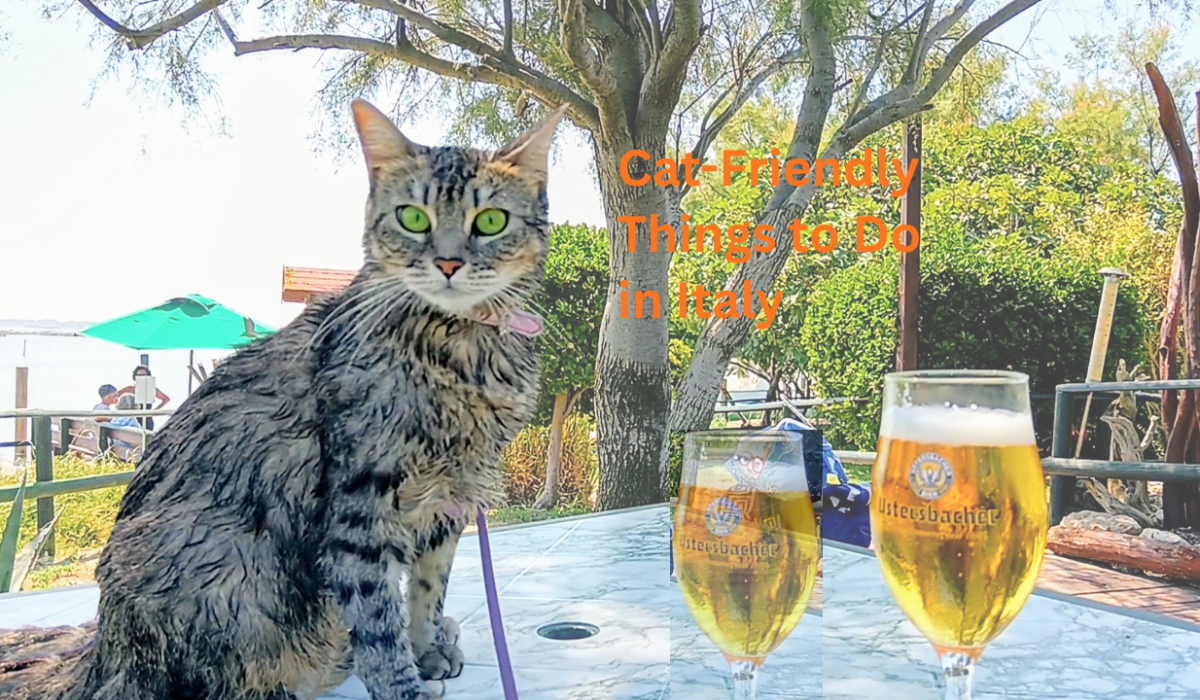
For Gigia, it’s the social experience. She can sit beside me, observe the passing humans, judge the dogs, appreciate the architecture and enjoy the adoration from passersby—high-fiving them should she please.
What to look for: Cafés with outdoor seating away from busy roads. Tables with some shade. Staff who don’t mind a cat sitting calmly beside you.
Gigia’s preference: She prefers terraces with a view of something interesting — a piazza, a church, a fountain, passing people.
7. Wine Country Experiences and Enoteche
Italy’s wine regions are exceptionally welcoming to cats. Vineyards are quiet, spaces are open and the culture of wine is about leisurely appreciation, not frantic activity.
Visiting an enoteca — a wine bar, sometimes attached to a vineyard — offers the chance to sit among barrels, taste wine and let your cat explore a calm, interesting space.
In practice: She inspects the barrels, sits on the cool floor, observes the other visitors and waits patiently for the inevitable attention from wine-loving humans. In Valdobbiadene, she took a hands-on approach to agriculture—inspecting the vines with the quiet confidence of a feline agricultural consultant.
For deeper exploration, see our guide to cat-friendly enoteche in Italy.
8. Local Markets (with Preparation)
Markets are among the most intense Italian experiences. Colour, noise, crowds, incredible food and a genuinely local atmosphere.
They can also be stressful for a cat.
The preparation: Visit early in the day, before the crowds build. Keep your cat in a carrier if the noise is too much. Stay near the edges of the market rather than the centre. Leave before you or your cat become overwhelmed.
Gigia’s experience: She is a regular at the markets, particularly in Treviso. She enjoys the many moving scenes and the diverse smells. At Valeggio sul Mincio’s antique fair, she inspected the precious goods and paused before a gilded mirror to look at her own furry image.
Examples: The Treviso market, the Verona market, the smaller weekly markets in provincial towns.
9. Monastery and Convent Gardens
Italy has hundreds of monasteries, convents and religious communities with gardens open to visitors — or at least visible from the street.
These are often among the quietest, most peaceful spaces in Italy. Ancient walls, cultivated gardens, fountains, shade, birds.
Gigia’s verdict: Her ideal hunting grounds for lizards. She loves the garden and monastery of San Francesco church in Treviso in particular.
Examples: The monastery gardens of Assisi, the convent cloisters of small towns, the hermitage gardens of the countryside, and the San Francesco church gardens in Treviso.
10. Staying at a Cat-Friendly Agriturismo
An agriturismo — a working farm offering accommodation — offers the best of both worlds: charming accommodations often set in natural environments where Gigia can explore.
You can settle into a rural environment where the pace is slower, the surroundings are quieter and, when the property permits it, there may be outdoor space for your cat to enjoy.
Sometimes the accommodation is the destination.
What makes it work: You can stay for several days. Your cat can gradually become comfortable with the surroundings. The farm itself becomes the experience.
For detailed recommendations, see our guide to cat-friendly agriturismi in Italy.
11. Scenic Train Journeys
The train journey itself can be an experience, not merely a way of getting somewhere.
Italy’s rail network passes through stunning landscapes: the Brenner Pass, the coast of Liguria, the hills of Umbria, the lagoons of Veneto.
For a cat, the train offers a contained, safe space from which to observe the changing world outside the window. Gigia has spent hours watching vineyards disappear, mountains appear and new cities arrive outside the glass.
Gigia’s favourite: She loves the ride from Treviso to Belluno in particular, which takes her through mountains and rivers.
For complete advice, see our guide to train travel with a cat in Italy.
12. Road-Trip Stops and Village Discoveries
If you’re travelling by car, the journey itself offers countless small experiences: stopping at a viewpoint, a farm shop, a roadside café, a small village you hadn’t planned to visit.
These are the moments Gigia enjoys most. The unexpected discoveries. The quiet lane that leads to a medieval church. The café where locals, not tourists, gather.
The key: Drive slowly. Stop often. Be willing to change your plan. The journey is the experience.
For detailed advice, see our guide to travelling with a cat by car.
13. Olive Grove and Vineyard Walks
Olive groves and vineyards are everywhere in Italy. And they are perfect for walking with a cat.
The trees and vines can provide shade, softer footing and a welcome escape from traffic. The views are beautiful. The pace is naturally slow.
Gigia’s approach: She walks through the groves, investigates the trees and vines, sits in the shade, observes the birds and sometimes — rarely — catches the scent of something interesting.
Where to go: Any olive-growing or wine-producing region. The most accessible groves and vineyards are often those around hill towns, where they begin within walking distance of the town centre.
14. Exploring Italy’s Small Islands and Lagoons
Italy has countless islands — not just the famous ones. Some are accessible by ferry, others by bridge.
The experience of an island is unique: enclosed, self-contained, often quiet, with water on all sides and a distinct sense of place.
From Gigia’s travels: She is wary of ferries, but once she reaches an island, she enjoys the exploration. The absence of cars, the calm, the fresh air.
Examples: The smaller islands of the Venetian lagoon, Torcello, and quiet lagoon destinations like Grado.
Special considerations: Choose quiet days. Avoid crowded ferries. Keep your cat in a carrier on the boat. Watch for heat and ensure water is always available.
15. Exploring Venice in the Quiet Hours
Venice is extraordinary for cats. Apart from the well-trodden landmarks, there are many quiet alleys and waterfront paths for a cat to explore.
But Venice is also challenging—crowds, heat, endless water.
Gigia’s verdict: She visits Venice in the off-season. She avoids St Mark’s Square at peak times. She explores the quiet districts: Cannaregio, Dorsoduro, Giudecca. She takes the vaporetto on calm days.
The key: Venice is best experienced slowly, early in the day, away from the main routes. The quiet campos in Dorsoduro or the waterfront walks in Cannaregio offer far more to a cat than the crowded tourist centres.
For complete advice, see our Venice with your cat guide and where to stay in Venice with a cat.
How to Plan a Day Around Your Cat
This is a long list. But you don’t need to do everything. In fact, you probably shouldn’t.
Choose experiences that:
- Match your cat’s personality. Some cats love crowds. Most don’t. You know your cat best.
- Fit the season. Summer in Italy can be hot. Choose shaded or air-conditioned experiences. Winter is quiet but can be cold.
- Match your travel style. If you’re travelling by train, focus on the train-friendly experiences. If you’re driving, the road-trip experiences will suit you.
- Allow time for rest. Don’t pack your day. Two experiences are enough. Three is a lot. One, done well, is perfectly sufficient.
- Prioritise what actually benefits your cat. The experiences where your cat can be present, comfortable and content are the ones worth choosing.
A Note on Preparing Your Cat for These Experiences
Before you try any of these experiences, prepare:
- Harness training. Most of these experiences assume your cat can walk calmly on a harness and lead. If your cat isn’t harness-trained, focus on carrier-friendly experiences first. A non-stretch harness is critical—it once saved Gigia’s life in the Venice lagoon.
- Carrier comfort. Your cat should see the carrier as a safe space, not a punishment. Travel with it regularly. Leave it open at home. A top-opening carrier allows your cat to emerge partially and observe while still feeling secure. See our best cat travel gear recommendations.
- Gradual exposure. Don’t start with the busiest market in Italy. Begin with a quiet village piazza. Build your cat’s confidence gradually.
- Know your cat’s limits. Some cats can manage two hours of exploration. Others are done after twenty minutes. Respect that.
- Always have an escape plan. If your cat becomes stressed, you need to be able to leave quickly. Don’t choose experiences that trap you in a crowded space with no easy exit.
For a broader preparation checklist before you leave home, see Before Travelling to Italy With Your Cat.
More Cat-Friendly Italy Guides
These guides take you further into the practical and experiential side of travelling through Italy with your cat:
Final Thoughts from Gigia
Italy isn’t merely a country where you can travel with a cat—it’s a country where travelling with a cat actually makes your trip better.
A cat slows you down, forces you to notice the details, keeps you off a rushed checklist, and reminds you that the best experiences are often the simplest ones.
Gigia doesn’t care about the famous sights. She cares about the sunbeam. The interesting doorway. The quiet corner. The passing pigeon.
So don’t treat this list as a rigid itinerary. Think of it as an invitation to slow down, observe, and let your cat decide what’s worth investigating.
Every cat is different. Always prioritise your cat’s comfort, monitor safety closely, and use these ideas as a flexible guide tailored to your feline companion’s unique personality.
Every cat is different. What works for Gigia may not work for your cat. Use these experiences as ideas, not prescriptions. You know your cat best. Always prioritise your cat’s wellbeing over any destination or activity.