Slow Travel in Italy: Why Travelling Like a Cat Is the Best Way to Experience Italy
When people dream of Italy, they often imagine an ambitious itinerary: Rome on Monday, Florence on Tuesday, Venice on Wednesday, the Amalfi Coast by the weekend.
The result can be a whirlwind of train stations, hotel check-ins, crowded attractions and endless photographs — but surprisingly few lasting memories.
Gigia has never understood this approach.
Cats don’t hurry.
They investigate. They observe. They stop whenever something captures their attention. They don’t care how many attractions they have visited today. They care whether this particular place is interesting.
Travelling with Gigia gradually changed the way I travelled too. Instead of asking, “What’s next?”, I began asking, “What am I missing?”
That change is at the heart of slow travel in Italy.
Slow travel isn’t simply about spending more time in beautiful places. It is about changing the way you move through them — allowing time for curiosity, local life, rest and the unexpected.
What Is Slow Travel?
Slow travel isn’t about moving slowly for the sake of it. It’s about travelling more thoughtfully.
Instead of racing through five destinations in a week, you spend several days in one place. You walk rather than drive whenever practical. You linger over lunch. You talk to local shopkeepers. You discover neighbourhood cafés. You leave enough space in the day for something unexpected to happen.
Rather than collecting destinations, you collect experiences.
Italy is particularly well suited to this philosophy because so much of its character exists outside the headline attractions: morning markets, family-run cafés, village bakeries, historic streets, quiet canals, small museums, local festivals and conversations with people who have lived in the same place for generations.
And when you travel with a cat, this philosophy becomes even more natural. Your companion already has a built-in resistance to the idea that every hour must be optimised.
Why Travelling with a Cat Changes the Way You Travel
Many people assume that taking a cat on holiday makes travel more complicated.
Sometimes it does.
But it can also force us to remove many of the habits that make travel exhausting in the first place.
Cats need breaks. They need comfortable places to rest. They need time to understand unfamiliar surroundings. They don’t particularly care whether you have managed to squeeze three museums and two churches into a single afternoon.
Because Gigia travels with me, I naturally began to:
- spend more nights in each destination
- choose accommodation more carefully
- avoid unnecessarily complicated itineraries
- build regular pauses into the day
- walk more
- look for parks, gardens and quieter streets
- leave space for unexpected discoveries
- accept that not every day needs to be productive
The result was not less travel.
It was better travel.
The cat who was supposedly making the journey more difficult was actually teaching me how to enjoy it.
What Does It Mean to Travel Like a Cat?
Cats are naturally curious without being hurried.
Gigia has taught me to notice details I might otherwise have overlooked:
- the sound of church bells echoing across a medieval square
- reflections dancing on a quiet canal
- an elderly couple greeting every shopkeeper by name
- a hidden courtyard filled with flowers
- the smell of fresh bread from a neighbourhood bakery
- afternoon light transforming an ordinary street
- a small piazza that suddenly becomes the centre of village life
She has never once suggested rushing to the next attraction.
Instead, she reminds me that some of the most memorable discoveries happen when nothing is planned at all.
How to Build a Slow Travel Itinerary in Italy
The biggest mistake people make when planning slow travel is to create a normal fast itinerary and simply call it “slow”.
Slow travel requires a different structure from the beginning.
Choose a Smaller Number of Bases
Instead of changing accommodation every night or two, consider staying longer in fewer places.
A good base gives you time to understand a destination rather than repeatedly spending your first day learning where the supermarket, pharmacy, café and quietest walking route are.
For a cat, this can be especially valuable because the accommodation gradually becomes familiar territory.
Group Experiences Geographically
Avoid crossing an entire city or region simply to tick off one attraction. Choose experiences that make sense together.
One morning might be devoted to a historic centre. Another might involve a market and a long lunch. A third might contain nothing more ambitious than a walk and a café.
This is not wasted time.
The empty spaces are part of the itinerary.
Leave Room for the Unexpected
A slow itinerary should contain some deliberately unplanned time.
That might be the afternoon when you discover a village festival, find a family-run restaurant, meet an unusually welcoming shopkeeper, or simply decide that the view from your accommodation is too beautiful to leave.
You cannot schedule those moments. You can only leave enough room for them to happen.
Slow Travel Doesn’t Mean Avoiding Italy’s Famous Cities
Slow travel is sometimes misunderstood as meaning that travellers should avoid Rome, Venice, Florence or other famous destinations altogether.
That’s not the point.
The same philosophy can transform the experience of a busy city.
Instead of trying to see every major attraction, choose a smaller number of places and give yourself time to experience the neighbourhood around them.
In Venice, for example, the difference between rushing from landmark to landmark and allowing yourself to wander through quieter streets can be enormous.
In Rome, choosing a calmer neighbourhood as your base can change the experience of the entire trip.
For travellers with cats, this becomes particularly important because the environment around your accommodation can influence how comfortable your companion feels.
For a city-specific example, explore our Exploring Venice with Your Cat guide, or use our guide to choosing quiet neighbourhoods in Italian cities when selecting a base.
Treviso Taught Us to Notice More
I was already living in Treviso before Gigia came into my life. But it was only after she began insisting on her daily outdoor adventures that I started seeing the city through completely different eyes.
Every day she would lead me a little farther — down a quiet alley, beside an overlooked canal, into a peaceful piazza or along a shaded riverside path.
What had once been familiar streets gradually became a collection of small discoveries.
Artisan workshops. Neighbourhood cafés. Quiet gardens. Local markets. Riverside paths. Corners of the city that many visitors simply walked past.
Living with Gigia didn’t make me discover Treviso — it made me truly notice it.
That experience is part of the reason Treviso remains such an important starting point within Gigia Travel Cat’s wider Veneto architecture.
For destination information, explore our Treviso Province Guide . For quieter discoveries around the region, see Treviso Hidden Gems .
And if you want to explore the wider region rather than Treviso alone, continue with Exploring Veneto Beyond Venice .
Slow Travel Works Especially Well in the Italian Countryside
Some landscapes naturally make it easier to slow down.
Italy’s countryside is one of them.
Vineyard roads, small villages, agricultural landscapes and quiet walking routes invite a different rhythm from major tourist centres.
But the countryside is not the subject of this philosophy. It is one of the places where the philosophy becomes particularly easy to experience.
If your ideal journey involves longer stays, rural accommodation, local food and days shaped by the landscape rather than a sightseeing checklist, continue with our dedicated guide:
Those pages go deeper into the rural landscape and accommodation choices, leaving this article free to concentrate on the broader philosophy of slow travel.
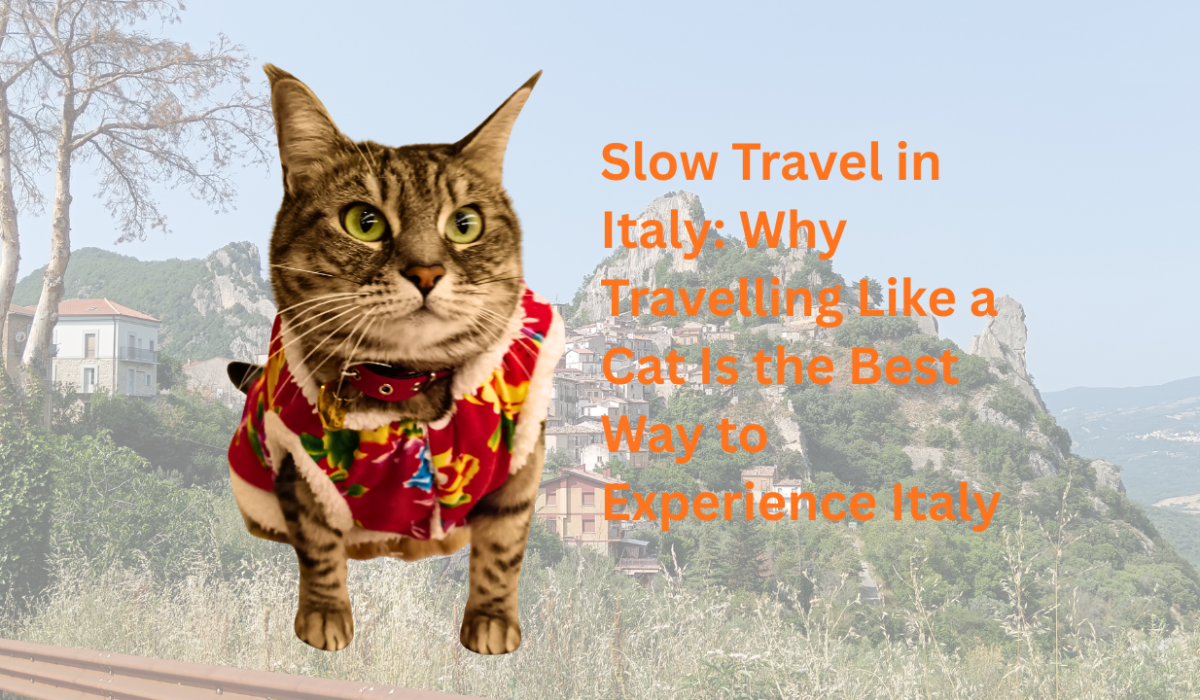
Why Slow Travel Works So Well in Italian Hill Towns
Italian hill towns are another natural fit for this way of travelling.
Their appeal is rarely about seeing one monument and leaving. It lies in wandering, stopping, looking, eating, observing and allowing the town to reveal itself gradually.
A slow-travel day in a hill town might mean breakfast in a small café, a walk through the historic centre, a quiet viewpoint, lunch that lasts longer than expected and an afternoon spent doing very little at all.
That is precisely the point.
If this style of destination appeals to you, our Best Italian Hill Towns for Calm Travel guide explores the destination side in greater depth.
Choose Accommodation That Makes Slow Travel Possible
Slow travel becomes much easier when your accommodation supports it.
The goal is not simply to find somewhere that accepts cats. It is to find a place where both of you can settle comfortably enough that staying longer becomes enjoyable.
Depending on the journey and the cat, useful characteristics may include:
- a quiet location
- a comfortable room or self-contained space
- secure doors and windows
- manageable access to outdoor areas where appropriate
- easy access to food and everyday services
- space for the cat to establish a familiar routine
- a location that reduces unnecessary daily transport
For the broader accommodation methodology, see our guide to finding truly cat-friendly accommodation in Italy .
If you want to compare accommodation types and browse Italian options, our Cat-Friendly Hotels in Italy guide provides a broader overview.
Slow Travel Also Changes Who Benefits From Your Journey
There is another reason slow travel matters.
When you move quickly through a country, your spending tends to concentrate around transport hubs, major attractions and large, high-volume businesses.
When you stay longer, you naturally begin using the businesses that make everyday life possible.
- family-run cafés
- independent restaurants
- local markets
- artisan workshops
- small accommodation providers
- regional food producers
- neighbourhood shops
You return to the same café. The owner begins to recognise you. You discover the bakery the locals use. You buy something from the shop you would never have noticed during a ten-minute sightseeing stop.
That is one of the quiet pleasures of staying somewhere long enough to become temporarily ordinary.
You stop being merely a visitor passing through.
For a little while, you become part of the rhythm of the place.
Why Slow Travel Can Be Better for Cats
Every cat is different, and travelling with a feline companion requires attention to the individual animal rather than a universal formula.
But for a cat who enjoys travelling, a slower itinerary can offer important advantages.
- fewer changes of environment
- more predictable daily routines
- more time to become familiar with accommodation
- less pressure to tolerate constant movement
- more opportunities for quiet observation
- longer periods of rest between outings
- more flexibility when the cat needs a slower day
This does not mean that every cat will enjoy travelling. Nor does it mean that every travelling cat should spend long periods outdoors.
It simply means that when a cat does travel successfully, designing the journey around her needs can make the entire experience more rewarding.
What Italy Has Taught Us About Travelling Slowly
After travelling thousands of kilometres across Italy together — from Alpine villages to Sicily — we’ve discovered that the richest journeys are rarely measured by distance travelled.
They’re measured by moments remembered.
- The conversation with a friendly shopkeeper.
- The tiny bakery discovered by accident.
- The quiet bench overlooking a landscape.
- The café owner who remembers your order.
- The village where you planned to stay for lunch and somehow remained until sunset.
- The unexpected road that turned into the best part of the day.
Those moments cannot be scheduled.
They can only be experienced.
And that may be the greatest lesson Gigia has taught me.
Where to Begin Your Own Slow Travel Journey in Italy
Slow travel does not require abandoning famous destinations or planning an entirely rural holiday.
It simply requires choosing a different rhythm.
The following guides can help you turn the philosophy into an actual Italian journey.
🐱 Start with the National Italy Guide
🌿 Explore the Italian Countryside
🏛️ Discover Quieter Destinations
🏨 Build a Comfortable Base
Why We Created Gigia Travel Cat
Gigia Travel Cat exists because we believe Italy deserves to be explored differently.
Our guides don’t simply tell you what to see. They invite you to slow down, stay curious and experience everyday Italian life — whether you’re travelling with a cat or simply sharing Gigia’s curiosity.
Gigia taught me that travel does not have to be a competition.
There is no prize for visiting the most cities. No medal for taking the fastest train. No achievement unlocked by seeing every major attraction in a single week.
There is only the experience itself.
And sometimes the experience becomes richer when we give it more time.
That is what slow travel means to us.
One Final Lesson from Gigia
Italy isn’t a country to conquer.
It’s a country to savour.
So whenever you find yourself wondering whether you’re travelling too quickly, simply ask yourself one question:
What would Gigia do?
She would pause.
She would look around.
She would find a sunny spot.
She would watch the world for a while.
And then, when she was ready, she would continue.
Because that’s often where the real Italy quietly reveals itself — not only in the famous landmarks, but in the moments between them.
And perhaps that’s the greatest lesson any travelling cat can teach us:
You don’t have to see everything to experience something deeply.
Continue Exploring Italy with Gigia
Explore the wider Italy-with-a-cat architecture, from practical planning to slow travel, countryside, regional destinations and feline-friendly accommodation.