Exploring Veneto Beyond Venice: Discover the Italy Most Visitors Miss
Every year, millions of travellers arrive in Venice believing they have seen Veneto.
Most spend two or three days exploring its canals before moving on, believing they’ve experienced the region.
In reality, they’ve only seen its most famous chapter.
Venice deserves its reputation. It is one of the world’s most extraordinary cities. But it is only one chapter of a much larger story — a region of vineyards, mountains, medieval villages, rivers, beaches, art cities and countryside that most visitors never discover.
When Gigia and I first began exploring Italy, we made the same mistake. We assumed Venice was the destination.
Then we started looking beyond the lagoon.
That decision completely changed the way we travel in northern Italy.
Some of our happiest discoveries happened in the places most travellers never reach: quiet canal-side towns, vineyard roads, medieval hilltop villages, riverside walks and family-run trattorias where the owners still remember your name.
This guide is an invitation to go further. It is an introduction to Veneto beyond Venice — the landscapes, towns, countryside and slower journeys that make the region worth exploring in its own right.
Why Veneto Is One of Italy’s Most Underrated Regions
Veneto is one of Italy’s most diverse regions.
Yet for many visitors, it begins and ends at Piazza San Marco.
The reality is far richer:
- the UNESCO-listed Prosecco Hills
- the dramatic peaks of the Dolomites
- medieval villages and hilltop towns
- rivers, lakes and the Adriatic coast
- Renaissance cities beyond Venice
- countryside, vineyards and olive groves
- distinctive local food traditions
- a slower, more relaxed rhythm of life
Veneto is also remarkably easy to explore. Unlike many larger Italian regions, many of its highlights sit surprisingly close together. You can enjoy breakfast beside Venice’s canals, lunch in Treviso and an aperitivo among the Prosecco vineyards all within the same broad journey — although Gigia would strongly recommend taking much longer.
Transport links are generally convenient, distances are manageable, and the region offers an unusually rich mixture of cities, countryside, mountains and smaller historic towns.
For an overview of the region’s geography, destinations and character, our Veneto Region Guide provides the wider starting point.
Venice Is Just the Beginning
Venice deserves its reputation.
No one should visit Veneto without experiencing its canals, bridges and extraordinary atmosphere.
But Venice is also intense. Its beauty can feel almost theatrical, and its narrow calli are often filled with crowds and high-season prices. For some, the spectacle is unforgettable; for others, it can leave them feeling more exhausted than restored.
If Venice is part of your journey, our Exploring Venice with Your Cat guide looks specifically at experiencing the historic city with a feline companion.
And if you are considering the mainland as a quieter base, our Venice Terraferma guide explores Mestre and Marghera beyond the lagoon.
But beyond the lagoon, Veneto begins to change character.
It’s a landscape made for slower exploration — exactly the kind of Italy Gigia loves most.
Quiet towns where locals outnumber tourists. Vineyards where the only sound is birdsong. Medieval villages where you can stop for coffee without a queue. Countryside where the rhythm of life is dictated by the seasons, not the tourist calendar.
Most visitors never discover this side of Veneto. That is their loss.
Treviso — The Region’s Best-Kept Secret
Treviso may be Veneto’s best-kept secret.
Fifteen minutes from Venice by train, it feels like a different world.
Canals wind through the historic centre, quieter and more intimate than Venice’s grand waterways. Medieval walls still encircle the old city. Elegant piazzas host morning markets and evening passeggiate.
The city is wonderfully walkable. Cafés spill onto pavements beside the canals. Artisan shops hide behind medieval arcades. Restaurants serve Veneto’s regional cuisine without the prices or crowds of Venice.
Treviso is also one of the best starting points for exploring Veneto beyond Venice. From here, you can reach the Prosecco Hills, medieval hill towns, riverside landscapes and dozens of smaller destinations without constantly changing accommodation.
If you want to understand the area in greater depth, begin with our Treviso Province Guide .
For ideas that can be explored from a Treviso base, see our 15 Best Day Trips from Treviso .
And for a road-based journey through the wider region, our Best Scenic Drives in Veneto guide explores routes, viewpoints and stops in greater detail.
A good base can make all the difference when travelling with a cat. Treviso combines a manageable historic centre with convenient connections into the surrounding countryside, allowing you to explore the region without constantly changing accommodation.
The Prosecco Hills
North of Treviso, the landscape begins to rise.
Gentle hills give way to steep vineyards, winding roads and villages perched among the vines.
This is the Prosecco Hills, a UNESCO World Heritage landscape stretching between Conegliano and Valdobbiadene.
The area is famous for Prosecco, but the experience is about far more than wine. Even visitors who never drink wine often describe this as one of the most beautiful landscapes in northern Italy.
Driving through the hills, you pass stone farmhouses, ancient abbeys, family-run wineries and panoramic viewpoints that seem to stretch forever. Small villages appear around every bend, each with its own character and traditions.
This is one of Veneto’s most beautiful landscapes — and one of its most rewarding for slow exploration.
For a broader road-based exploration of the region, continue with our Best Scenic Drives in Veneto guide.
Medieval Towns Worth Discovering
Veneto is dotted with medieval towns, each with its own character.
Rather than rushing through several towns in a single day, choose one or two and give yourself time simply to wander.
Some are walled and fortified. Others perch on hilltops. Many have preserved their historic centres with remarkable care.
Asolo is one of the region’s most beautiful hilltop towns, known for Renaissance elegance, panoramic views and a long association with artists and writers.
Bassano del Grappa sits beside the Brenta River, famous for its wooden bridge and the grappa distilleries that have defined the town for centuries.
Castelfranco Veneto is a beautifully preserved walled town, birthplace of the Renaissance painter Giorgione and surrounded by productive countryside.
Cison di Valmarino is officially one of Italy’s Most Beautiful Villages, a medieval gem nestled among the Prosecco Hills with a castle, cobbled streets and artisan workshops.
Marostica is famous for its living chess game, medieval walls and two castles overlooking the surrounding countryside.
Each town is worth visiting in its own right. Together, they reveal Veneto’s remarkable diversity.
If this quieter style of historic-town travel appeals to you, our Best Italian Hill Towns for Calm Travel guide explores the wider idea in greater depth.
Padua — A Renaissance City Worth Discovering
Padua deserves special mention. Home to one of Europe’s oldest universities, Giotto’s extraordinary Scrovegni Chapel and elegant arcaded streets, it offers world-class culture without Venice’s crowds.
Even a day trip reveals why many Italians consider Padua one of the country’s most liveable cities.
It is also a useful reminder that Veneto’s appeal is not limited to small towns and countryside. The region’s larger cities each offer a different version of its history and culture.
Veneto’s Rivers, Nature & Countryside
Beyond the towns and vineyards, Veneto’s countryside offers some of Italy’s most peaceful landscapes.
The Sile River flows through Treviso Province, lined with ancient watermills, herons and quiet walking paths. Cycling routes follow its banks, connecting villages and countryside.
Vineyards stretch across the Prosecco Hills, changing colour with the seasons. Olive groves, wheat fields and orchards fill the plains. The landscape is alive with birds, wildflowers and the rhythms of rural life.
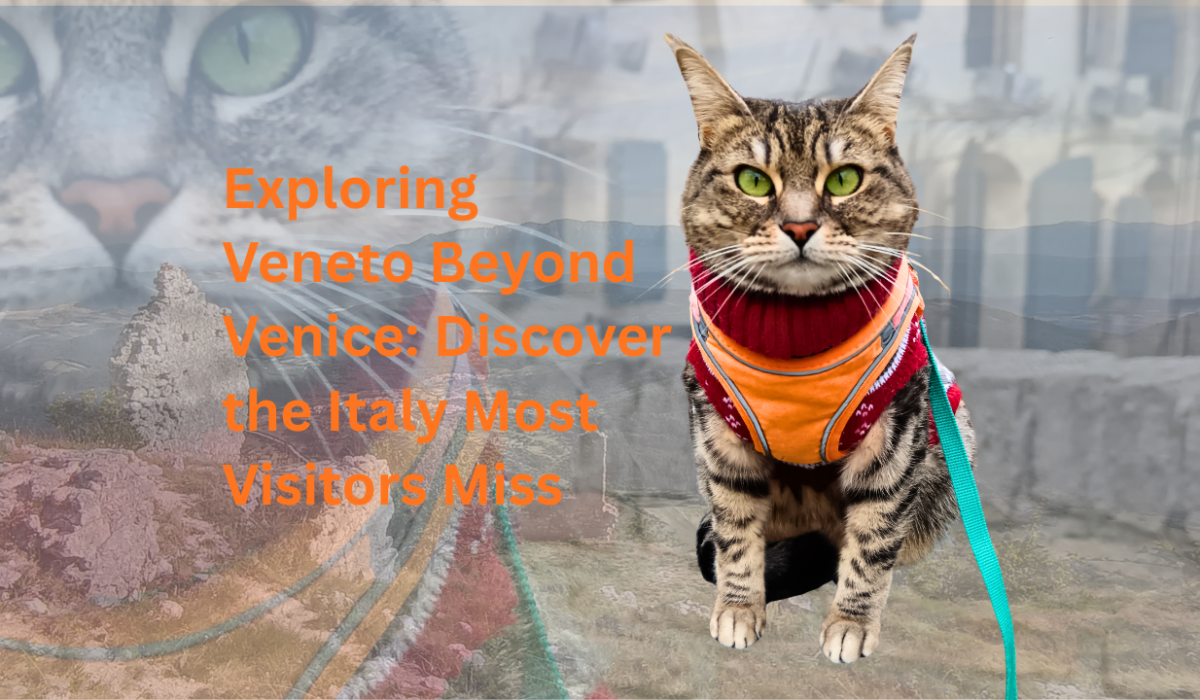
Gigia loves these places.
In the countryside, she relaxes. She investigates interesting smells. She finds warm stones and sunny spots. She watches birds and butterflies without the stress of city traffic.
This is where travel becomes truly restorative.
We’ve written more about this relationship between cats, landscape and slower travel in our guide to Why Cats Love the Italian Countryside .
Why Veneto Works So Well for Slow Travel
Veneto naturally encourages slow travel.
In the cities, you can wander without a plan. In the countryside, you can drive without a destination. Every village has a café where you can stop, every piazza a bench where you can rest.
The region rewards curiosity.
A coffee can last an hour. Lunch can stretch into the afternoon. An unexpected road can lead to a medieval village you’d never planned to visit.
For travellers with cats, this rhythm can be especially appealing. Fewer rushed transfers, less constant relocation and more time to settle into a comfortable base can make a journey easier for both cat and human.
For the broader philosophy behind this style of travel, read our Slow Travel in Italy guide.
Travelling Veneto with a Cat
Veneto can be particularly rewarding when travelling with a cat because the region offers such a wide range of environments: compact historic towns, quiet countryside, scenic roads and spacious rural accommodation.
The key is not to assume that every destination will suit every cat. Instead, choose accommodation and transport around your individual cat’s temperament, tolerance for noise and comfort with new environments.
For the practical foundations of travelling throughout Italy with a cat — including transport, preparation, safety and accommodation strategy — see our Ultimate Guide to Travelling Italy with Your Cat .
For additional practical advice from Gigia’s experience, our Feline Influencer’s Guide to Cat Travel covers the broader lessons we’ve learned from travelling together.
Not every beautiful place is automatically a good place for every cat. The best journeys leave room for your cat’s temperament, curiosity and need for rest.
Local Food Beyond Venice
Veneto’s food culture extends far beyond Venetian seafood.
Each part of the region has its own specialities, shaped by the surrounding landscape.
Treviso is famous for Radicchio Rosso di Treviso. The city also has a long association with Tiramisù. The Prosecco Hills produce Italy’s most famous sparkling wine. The foothills and mountain plateaus yield aged cheeses and distinctive local ingredients.
Regional dishes include:
- Radicchio Rosso di Treviso in risottos and grilled dishes
- Tiramisù and its long-standing Treviso connection
- Prosecco from the hills between Conegliano and Valdobbiadene
- Asiago cheese from the mountain plateaus
- Bigoli pasta, served with duck or sardines
- Polenta, a Veneto staple
Eating in Veneto is rarely rushed. Meals are enjoyed slowly, with local wine, good company and conversations that last long after the plates have been cleared.
Why Veneto Merits Returning
We have travelled all over Italy.
Yet Veneto keeps pulling us back.
Not because it is dramatic — though parts of it are spectacular. Not because it is famous — though Venice certainly is.
Because it feels lived in.
Because life here still revolves around local communities rather than tourism.
Because it is comfortable.
Because every visit reveals something new.
A village we missed. A road we hadn’t driven. A restaurant we hadn’t discovered. A vineyard we hadn’t explored.
Whether we’re wandering through Treviso, stopping for lunch in Asolo, exploring Verona’s quieter streets or driving across the Prosecco Hills, Veneto somehow always persuades us to stay one day longer than planned.
Gigia feels at home here. The countryside restores her. The towns welcome her. The slower rhythm suits her perfectly.
Perhaps that is why we keep returning, why we chose to make our home here in Treviso. It isn’t a place we visit; it’s a place we live.
Veneto doesn’t try to impress. It simply invites you to stay.
Suggested Veneto Itineraries
Our Best Scenic Drives in Veneto guide goes deeper into the region’s driving routes, viewpoints and stops.
Here, we’ve kept things simple: these are examples of how you might combine destinations rather than detailed road-trip itineraries.
🐾 3-Day Escape
Treviso → Asolo → Prosecco Hills
A compact introduction to Veneto’s canals, medieval hill towns and vineyard landscapes.
🐾 4-Day Veneto
Treviso → Bassano del Grappa → Asiago Plateau → Valdobbiadene
A varied journey from the plains into the mountains and back through the Prosecco Hills.
🐾 7-Day Veneto
Treviso → Asolo → Bassano del Grappa → Asiago Plateau → Conegliano → Valdobbiadene → Castelfranco Veneto → Treviso
A broader regional loop combining countryside, mountains, vineyards and historic towns.
For the detailed driving routes, hidden stops and viewpoints, continue to our Best Scenic Drives in Veneto guide.
How Veneto Fits Into a Wider Italy Trip
Veneto works particularly well as part of a wider Italian itinerary. Venice provides the iconic urban experience; Treviso offers a quieter regional base; the Prosecco Hills and medieval towns add countryside and culture; and the mountains provide a completely different landscape.
For broader planning, transport logistics, accommodation strategy and multi-region travel with a cat, continue to our Ultimate Guide to Travelling Italy with Your Cat .
Where to Start
🌿 Explore Treviso
If Treviso is going to be your base, start with the Treviso Province Guide for the wider geography, towns and character of the province.
Then use 15 Best Day Trips from Treviso for ideas beyond the city itself.
🗺️ Explore Veneto by Road
🏛️ Explore Venice
🐾 Travel with Your Cat
One Final Reflection
Venice is extraordinary.
But Veneto begins where most visitors stop looking.
Follow the quieter roads.
Stop in the small villages.
Sit in the village piazzas.
Walk through the vineyards.
Discover the Italy that most visitors never find.
That’s where the real Veneto reveals itself.
Venice may be where most journeys begin. But the Veneto you’ll remember is the one waiting beyond the crowds. That’s where Gigia still leads me — and where I hope she’ll lead you too.