Best Italian Hill Towns for Calm Travel (2026 Guide)
Italy does not lack beautiful places. What can be harder to find is a beautiful place where you can actually slow down, breathe, wander and let your surroundings unfold around you.
That is one reason we have become so fond of Italy’s hill towns.
Rising above valleys, vineyards and plains, these small towns often have medieval streets, compact historic centres, quiet corners and extraordinary views. Some are famous. Others are barely known outside their own region.
For travellers with cats, they can offer something even more valuable: space, manageable surroundings and a slower rhythm of exploration.
If you are planning a longer journey through Italy with your cat, our Ultimate Guide to Traveling Italy with Your Cat covers the broader practicalities of travelling around the country.
Why Italian Hill Towns Work So Well for Cat Travel
Hill towns were generally built for defence, community and self-sufficiency rather than for modern traffic. Their historic centres are often compact, their streets narrower and their pace of life noticeably different from that of Italy’s largest tourist cities.
Of course, no hill town is automatically cat-friendly. A beautiful medieval village can still be difficult if it is packed with tour groups, dominated by cars or surrounded by steep terrain.
But when the conditions are right, the very characteristics that make these places distinctive can also make them rewarding destinations for a travelling cat.
These qualities do not mean that every cat will enjoy a hill town. Cats differ enormously in confidence and temperament. What matters is finding an environment that suits your particular companion.
What Makes a Good Hill Town for a Cat?
When we assess a hill town, we look beyond photographs and tourist rankings. Gigia’s experience has taught us that the details on the ground matter far more.
Our hill-town checklist includes:
- ✔ How much vehicle traffic reaches the historic centre?
- ✔ Is there a genuinely pedestrian-friendly area?
- ✔ Are there quiet streets away from the busiest viewpoint?
- ✔ Can you reach the town without an exhausting journey from your base?
- ✔ Are there shaded areas or places where your cat can pause?
- ✔ Is the terrain practical for your cat’s walking ability?
- ✔ Can you visit outside peak tourist hours?
- ✔ Is there suitable accommodation nearby?
The last point is particularly important. The best hill town for your cat may not be the one where you stay directly inside the historic centre. Sometimes a quiet property just outside town provides a much better base.
For help assessing accommodation specifically for feline travellers, see our guide to finding truly cat-friendly accommodation in Italy.
Our Favourite Italian Hill Towns for Cat Travel
These are not presented as a definitive ranking. Each town offers something different, and what works beautifully for one cat may not suit another.
🏰 Bardi — Medieval Walls and Wild Space
Rising dramatically above the Ceno Valley in Emilia-Romagna, Bardi is dominated by its imposing medieval castle and surrounded by a landscape that feels wonderfully expansive.
What we loved most was the sense of space. Bardi does not seem arranged around mass tourism. The castle, views and surrounding landscape create room for exploration and observation.
For Gigia, the castle was not simply a monument to photograph. It was an opportunity to investigate every wall, edge and elevated viewpoint — with the usual reminder that a curious cat near a medieval drop requires a very attentive human.
🏛️ Castell’Arquato — Compact Medieval Charm
Castell’Arquato in Emilia-Romagna offers a particularly appealing combination: an exceptionally atmospheric medieval centre without the scale or intensity of Italy’s major tourist destinations.
Its historic streets create a strong sense of place, while the compact layout makes it easier to explore at a measured pace.
That predictability can be useful when travelling with a cat. Rather than constantly moving between major attractions, you can concentrate on one small environment and let your cat investigate it gradually.
🌄 Civita di Bagnoregio — Dramatic Isolation
Civita di Bagnoregio in Lazio is one of Italy’s most visually extraordinary hilltop settlements. Reached by a pedestrian bridge, the historic town sits dramatically above the surrounding landscape.
Its restricted access creates an unusual sense of separation from the modern world. There are no ordinary cars moving through the historic centre, and the views are spectacular.
But Civita also illustrates an important lesson: car-free does not automatically mean easy for every cat. The approach, bridge and terrain require careful consideration, particularly in hot weather or with a cat that is uncomfortable with exposed or steep environments.
🎨 Valloria — Art, Silence and Hidden Liguria
Valloria in Liguria is famous for its painted doors, but its greatest attraction for us is the atmosphere created by its small scale and quiet lanes.
This is the kind of place where exploration becomes the activity itself. There is no reason to rush from one major attraction to another. You can wander, stop, observe a painted doorway and continue when something else catches your attention.
That rhythm suits the way Gigia naturally travels. She has never been especially interested in following a sightseeing checklist.
Abruzzo: Where Gigia Found the Most Freedom
If we had to choose one region that particularly changed our perception of Italian hill-town travel, it would be Abruzzo.
Compared with some of Italy’s better-known destinations, Abruzzo can feel more spacious and less dominated by international tourism. Its mountain landscapes, historic villages and hilltop settlements create an environment in which the journey itself becomes part of the experience.
🐾 Gigia’s Abruzzo Report
Gigia seemed noticeably more relaxed in parts of Abruzzo. There was less stimulation, fewer crowds and more opportunity to pause and observe.
Her verdict was characteristically direct:
“The hills were open. The crowds were absent. The exploration was unrestricted. Abruzzo understood what a cat needs: space.”
Some of the places that particularly stayed with us include Pennadomo, with its dramatic rocky landscape; Silvi Alta, overlooking the Adriatic; and Scanno, one of Abruzzo’s most beautifully preserved mountain villages.
If you want to explore the region more broadly, our Abruzzo Travel Guide covers the region beyond the hill-town experience.
Labro and Other Hill-Town Discoveries
Some of Italy’s most rewarding hill towns are not necessarily the ones appearing on every international travel list.
Labro in Lazio, overlooking Lago di Piediluco, is a good example. Its small scale and elevated position create a very different experience from visiting a major Italian city.
Assisi is much better known, but its hilltop position and surrounding landscape demonstrate that a famous destination can still contain quieter experiences when approached thoughtfully and outside the busiest periods.
The important distinction is not simply famous versus unknown. It is whether you can find the right part of the destination, at the right time, for your cat.
How to Explore a Hill Town with Your Cat
A hill town does not have to become an exhausting day of sightseeing. In fact, the opposite approach often works better.
Our approach with Gigia:
- 🐾 Arrive before the busiest part of the day whenever possible.
- 🐾 Allow time to investigate rather than following a strict route.
- 🐾 Build in pauses rather than treating every stop as wasted time.
- 🐾 Look for shade and quiet areas in warmer weather.
- 🐾 Keep your cat secure around walls, roads, viewpoints and unfamiliar terrain.
- 🐾 Leave the town before your cat becomes overstimulated or tired.
This is where travelling with a cat can actually improve the experience. You become much more aware of temperature, noise, distance, rest and the character of individual streets.
Instead of asking how many sights you can fit into a day, you start asking whether the place is giving both of you enough time to enjoy it.
How Many Hill Towns Should You Visit?
One of the easiest mistakes is turning a collection of beautiful hill towns into another sightseeing checklist.
Five towns in five days may sound impressive. With a cat, it can mean repeated journeys, unfamiliar accommodation, disrupted routines and very little time for either of you to settle into a place.
A better pattern is often:
That approach fits naturally within the broader principles of slow travel in Italy, but the focus here is specifically on using hill towns as destinations and bases for cat-friendly exploration.
Where to Stay When Visiting an Italian Hill Town
The most attractive accommodation is not always the most practical.
Staying directly on a busy central piazza may sound romantic, but it can mean restaurant noise late into the evening, passing visitors and little opportunity for your cat to settle.
For many cats, a quieter property on the edge of town or just outside the historic centre can be a much better choice.
When choosing accommodation, consider:
- ✔ noise levels during the evening
- ✔ proximity to busy restaurants and bars
- ✔ safe access to the property
- ✔ whether the accommodation gives your cat a quiet place to retreat
- ✔ parking and access if the town restricts vehicles
- ✔ whether the property genuinely understands cats rather than simply accepting pets
Best Seasons for Italian Hill Towns with a Cat
Spring and autumn are generally our favourite periods for exploring hill towns. Temperatures are often more comfortable, the light is beautiful and many places are considerably less busy than during the height of summer.
Whatever the season, check the specific conditions of the town you are visiting. A quiet village on an ordinary Tuesday can become a completely different place during a local festival.
Tuscany and Other Italian Regions for Hill-Town Travel
Hill towns are scattered throughout Italy, and each region gives them a different character.
Tuscany is particularly rich in hilltop towns, and it can work beautifully as part of a cat-friendly itinerary when you choose your base and timing carefully. For a broader regional guide, see Tuscany with Your Cat.
Abruzzo remains one of our favourite regions for this style of travel, while Lazio, Liguria and Emilia-Romagna also have plenty of smaller hill-town destinations worth exploring.
Rather than trying to cover every region on this page, we keep the focus here on the characteristics that make a hill town work for feline travel.
Italy Looks Different from a Hilltop
There is something special about arriving in a hill town after spending time on Italy’s busier roads.
The traffic falls away. The landscape opens. A medieval street leads somewhere you did not expect. A café owner recognises a neighbour. A bell sounds across the valley.
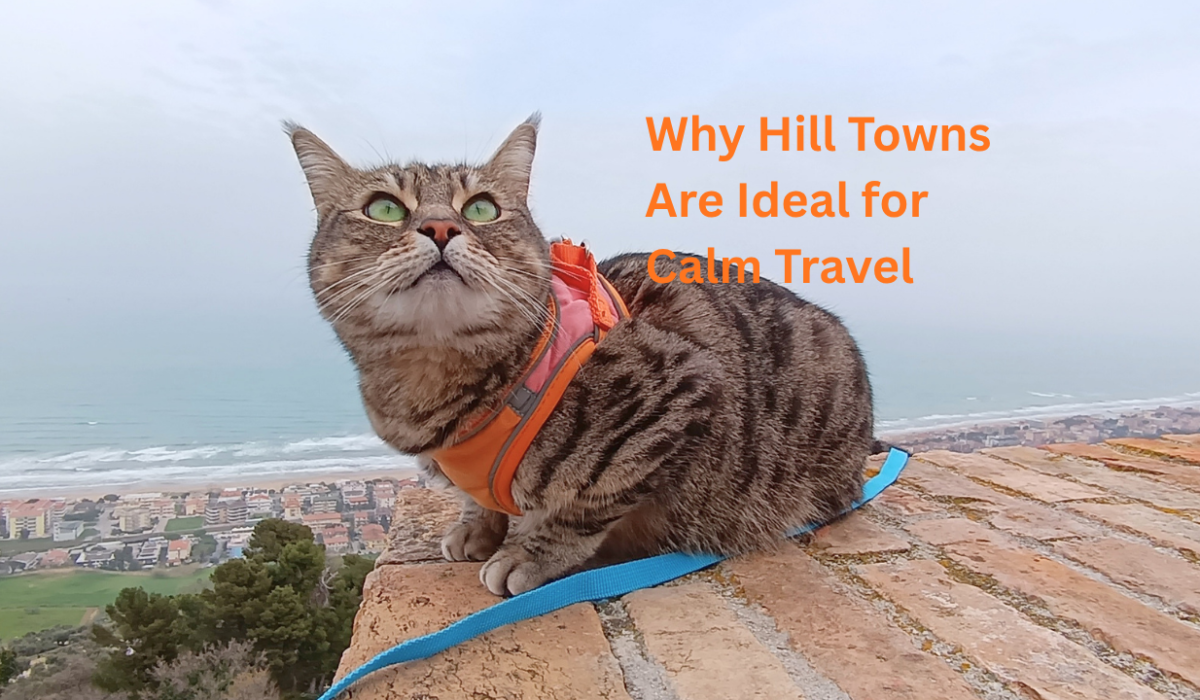
And then your cat stops.
Not because she has reached the next attraction on your itinerary, but because something has caught her attention.
That moment is worth remembering.
Travelling with Gigia has taught us that the best destinations are not necessarily the ones with the longest list of things to see. They are the ones that give you enough room to notice what is already there.
Final Perspective
Italian hill towns offer a different way to experience the country: smaller, slower and often closer to the landscape around them.
For travellers with cats, they can also provide an opportunity to build journeys around observation rather than constant movement.
The secret is not finding the single “most cat-friendly” hill town in Italy. It is learning to recognise the characteristics that make a particular place work for your cat.
For Gigia, those characteristics are remarkably consistent: space, interesting smells, somewhere to observe and, ideally, fewer people telling her where she should go.
For us, that has become one of the great pleasures of travelling through Italy.
We are not trying to conquer every hill town.
We are simply looking for the next one that makes Gigia stop and look.