Tuscany Accommodation Guide for Cat Owners (2026): Safe Areas, Property Types & Smart Booking Strategy
“
“Lucca: excellent structure. Saturnia: wonderful freedom — supervised. Open villas: questionable decisions. In Tuscany, where you stay can make all the difference.”
— Gigia
🐾 Planning the whole region?
This guide answers the question “Where should we stay?” For the wider itinerary, attractions, routes and things to do, continue to our Tuscany with a Cat guide.
If you are choosing accommodation anywhere in Italy rather than Tuscany specifically, our
Italy accommodation guide for cat owners
provides the broader national picture.
This guide answers the question “Where should we stay?” For the wider itinerary, attractions, routes and things to do, continue to our Tuscany with a Cat guide.
Why Your Tuscany Base Matters So Much
Tuscany is different from a typical city destination. Outside the historic centres, accommodation can be surrounded by open fields, vineyards, woods, wildlife and roads with little pedestrian infrastructure. That creates an important distinction for cat travellers: A peaceful environment is not automatically a safe environment. For a cat, the ideal property is not necessarily the most isolated or the one with the largest garden. What matters is whether you can control the environment and maintain a predictable daily routine. Look for:- clearly defined property boundaries
- secure windows and doors
- a self-contained living space
- limited uncontrolled animal activity
- reasonable access to roads and services
- a calm environment without excessive guest traffic
Best Areas to Stay in Tuscany with a Cat
There is no single “best” Tuscan base for every cat. The right choice depends on whether you prioritise controlled urban surroundings, countryside exploration, thermal landscapes, or access to Florence.1. Lucca — Best for a Structured, Manageable Base
Lucca is one of the most appealing choices if you want Tuscany without immediately committing to an isolated countryside property.
Its historic walls create a strong sense of spatial definition, while the compact centre makes it easier to establish a predictable routine.
For a cat that is comfortable with urban exploration or supervised outdoor time, Lucca can provide an attractive balance between culture and manageable surroundings.
Best for: travellers who want a structured town base, walkability and easier access to services.
Accommodation strategy: prioritise quiet apartments or smaller pet-friendly hotels rather than properties directly beside busy roads or nightlife areas.
For the wider experience of visiting the region with your cat, see our
Tuscany with a Cat guide.
2. Saturnia — Countryside Freedom with the Right Property
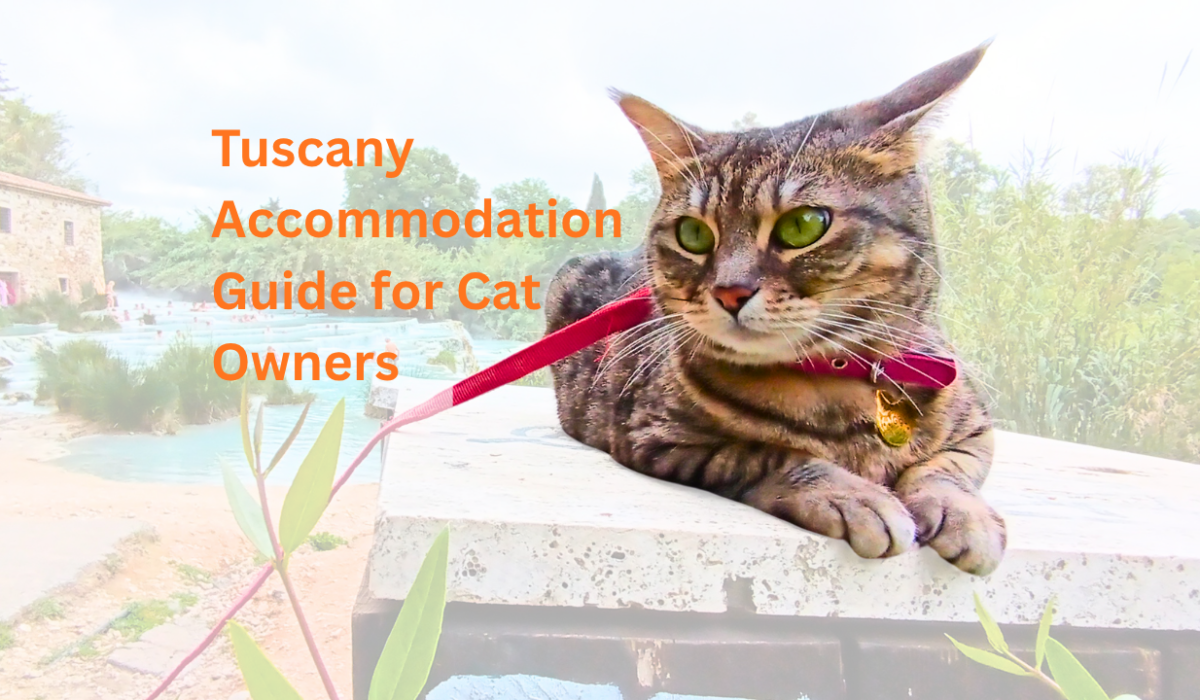
Saturnia offers a completely different experience. The area is known for its thermal springs, open countryside and low-density surroundings.
For a cat who enjoys exploring, this can be wonderful — provided outdoor access remains controlled.
The important question is therefore not simply whether a property has a garden.
Ask whether the garden is enclosed, what animals live on the property, how close the nearest road is, and whether your accommodation has secure doors and windows.
Best for: experienced cat travellers who want rural surroundings while maintaining supervision.
For more affordable rural options, see our
budget-friendly farm stays in Italy.
For a broader look at farm-based accommodation across the country, our
cat-friendly agriturismo guide
covers the wider category.
3. Val d’Orcia — Beautiful, but Property Selection Is Critical
Val d’Orcia is perhaps the quintessential Tuscany landscape: rolling hills, vineyards, cypress-lined roads and isolated stone buildings.
For humans, it can look like the perfect rural escape.
For cats, however, the openness needs careful consideration.
Many countryside properties are surrounded by unfenced land, wildlife and roads. A beautiful panoramic location may therefore require considerably more supervision than a compact town apartment.
Best for: experienced travellers who are comfortable managing controlled outdoor access.
4. Florence Countryside — A Better Alternative to the City Centre
Florence is one of Tuscany’s major attractions, but staying directly in the historic centre is not necessarily the easiest option with a cat.
The surrounding countryside can offer a useful compromise: easier parking, more space and less continuous pedestrian activity while keeping Florence within reach.
When choosing a property outside Florence, pay particular attention to road access and whether the accommodation is genuinely self-contained.
Best for: travellers combining Florence sightseeing with a quieter accommodation base.
🐾 Gigia’s Real-World Insight
“In Tuscany, behaviour changes. A city cat can suddenly become much more curious and exploratory. Quiet surroundings are wonderful — but quiet does not mean that every open door or field is a good idea.”Which Type of Accommodation Works Best?
The accommodation category matters almost as much as the location. In Tuscany, I would generally rank the options like this:✅ 1. Self-Contained Apartments
Often the easiest choice for cat travellers.- more control over doors and visitors
- fewer shared spaces
- easier feeding and sleeping routines
- usually more practical for longer stays
✅ 2. Small, Carefully Selected Agriturismi
Agriturismi can be excellent for cats, but the category is extremely broad. Prioritise smaller, owner-managed properties where you can establish exactly what the accommodation is like before arrival. Ask about resident dogs, livestock, open areas and whether your accommodation has its own entrance.⚠️ 3. Private Villas
Villas can be wonderful for families and groups, but they require more careful screening when travelling with a cat. A private garden is only an advantage if you can control access to it. Before booking, establish whether the property is fenced, whether gates close securely, and whether there are roads or neighbouring properties nearby.⚠️ 4. Large Resorts and Busy Hotels
These are not automatically unsuitable, but the combination of shared corridors, frequent housekeeping, open entrances, lifts and many unfamiliar people can make some properties less convenient for cats. If you choose a larger hotel, request a quiet room and ask specifically about secure windows and low-traffic areas.
🐾 Remember: “Pets allowed” tells you very little about whether a property is genuinely practical for a cat. The physical layout and operating environment matter just as much as the pet policy.
What to Check Before Booking a Tuscany Property
Before paying for a countryside stay, check the property rather than relying solely on photographs or the words “pet friendly”.
Ask these questions before confirming:
For the full property-screening process, including the questions worth asking hosts, see
How to Find Truly Cat-Friendly Accommodation in Italy.
- Are there free-roaming dogs on the property?
- Are there cats, livestock or other animals living on site?
- Is the garden fenced?
- Are gates securely closed?
- Are windows secure?
- Does the accommodation have its own entrance?
- Is the unit self-contained?
- Is the property close to a busy road?
- Are there shared outdoor areas?
- Can the cat remain safely indoors without difficulty?
Booking Strategy: How to Save Money and Avoid Problems
Once you know which area and property type you want, the booking process becomes much easier.Step 1: Shortlist Properties
Use major accommodation platforms to understand prices, availability, location and guest reviews.Step 2: Investigate the Property Beyond the Listing
Look carefully at photographs of entrances, windows, gardens, parking areas and surrounding roads.Step 3: Contact the Property Directly
A direct message can reveal information that is rarely included in a booking-platform description. A useful question is:
“We are travelling with a cat. Is the accommodation quiet and self-contained? Are there other animals on the property, and are the windows and doors secure?”
Step 4: Request the Right Unit
If the property has several rooms or apartments, ask for the quietest available unit. A ground-floor room may be useful in some circumstances, but only if the doors, windows and surrounding area are secure.Step 5: Confirm the Pet Policy in Writing
Do not assume that “pets allowed” automatically means cats are accepted under the same conditions as dogs. Confirm:- cats are accepted
- any pet fee
- any restrictions
- whether pets may access outdoor areas
- whether there are additional rules for the property
Pet Fees in Tuscany: What to Budget For
Pet charges vary considerably between properties. Common structures include:- €5–€15 per night — often used for shorter stays
- €25–€50 per stay — sometimes preferable for longer visits
- No additional fee — occasionally offered by smaller or owner-managed properties
How This Guide Fits with Your Tuscany Trip
This page has one specific job: helping you decide where to base yourself in Tuscany. Once you have chosen your base, move to our Tuscany with a Cat guide for the wider destination experience — including places to visit, regional ideas and practical travel planning. Think of the two pages this way:- This guide: WHERE to stay
- Tuscany with a Cat: WHAT to do and how to experience the region
- Cat-Friendly Accommodation Guide: HOW to evaluate accommodation anywhere in Italy
- Budget Farm Stays Guide: WHERE to find more affordable rural accommodation
- Cat-Friendly Agriturismo Guide: HOW the wider agriturismo category works across Italy