Tuscany with a Cat: Where to Stay, What to Know & How to Travel Smart (2026 Guide)
Tuscany is one of Italy’s most rewarding regions to explore with a cat.
Its vineyards, medieval towns, quiet country roads and rolling landscapes make it very different from travelling with a cat through a large city. But Tuscany also requires a different kind of planning.
There is more space—but space is not automatically safety. There are open gardens, rural roads, wildlife, farm animals and properties that may have few physical boundaries. The most beautiful place to stay is not necessarily the easiest place for a cat.
The key is to slow the journey down.
That philosophy is part of a wider approach to travelling with a cat. If you are planning your first trip or want to understand the practical framework behind travelling throughout Italy, start with our Ultimate Guide to Traveling Italy with Your Cat.
For a more detailed look specifically at choosing accommodation, property types and booking decisions in Tuscany, continue to our Tuscany Accommodation Guide for Cat Owners.
Why Tuscany Can Be So Good for Cats
Tuscany has something that many heavily visited Italian destinations lack: space and rhythm.
Instead of moving constantly between major attractions, you can build a slower journey around one or two bases. A morning walk, a quiet village, a long lunch and an afternoon back at your accommodation can become the itinerary.
For a cat, that slower rhythm can be valuable.
- Fewer accommodation changes can make adaptation easier.
- Quieter surroundings can reduce sensory overload.
- Longer stays give your cat time to establish familiarity.
- Car travel makes rural areas easier to reach without repeatedly changing transport.
- There is more opportunity for controlled outdoor exploration where conditions are suitable.
This is why Tuscany fits particularly naturally into the philosophy behind our guide to Slow Travel in Italy: travelling at a cat’s pace can mean seeing less, but experiencing more.
But Tuscany also demands responsible supervision. A quiet field can still lead to a road. A beautiful villa can have an unfenced garden. A rural property can have dogs, livestock or wildlife nearby.
Calm is valuable. Control is essential.
Where to Go in Tuscany with a Cat
🌿 Val d’Orcia — The Classic Tuscan Landscape
Val d’Orcia is the Tuscany many people imagine: rolling hills, vineyards, cypress-lined roads and stone farmhouses.
For cat travellers, its greatest advantage is not simply scenery. It is the possibility of building a slower itinerary around one carefully chosen base.
Stay longer, explore selectively and treat the accommodation as part of the experience rather than somewhere you simply sleep between sightseeing stops.
Best for: slow travel, countryside stays, photography, scenic drives and travellers comfortable with careful supervision.
🍷 Chianti — Countryside with Easier Access
Chianti offers a useful compromise between rural Tuscany and access to better-known destinations.
Its position between Florence and Siena makes it practical for travellers who want countryside accommodation without completely disconnecting from major cultural centres.
For a cat, however, the same rules apply: choose the property carefully, check the surrounding roads and animals, and do not assume that a large garden means a cat should be allowed to roam freely.
Best for: travellers combining countryside relaxation with day trips.
🌿 Saturnia & Maremma — Southern Tuscany at a Slower Pace
Southern Tuscany offers a different atmosphere from the region’s more heavily visited areas.
Saturnia is famous for its thermal springs, while the surrounding Maremma landscape provides a quieter rural setting and a strong sense of space.
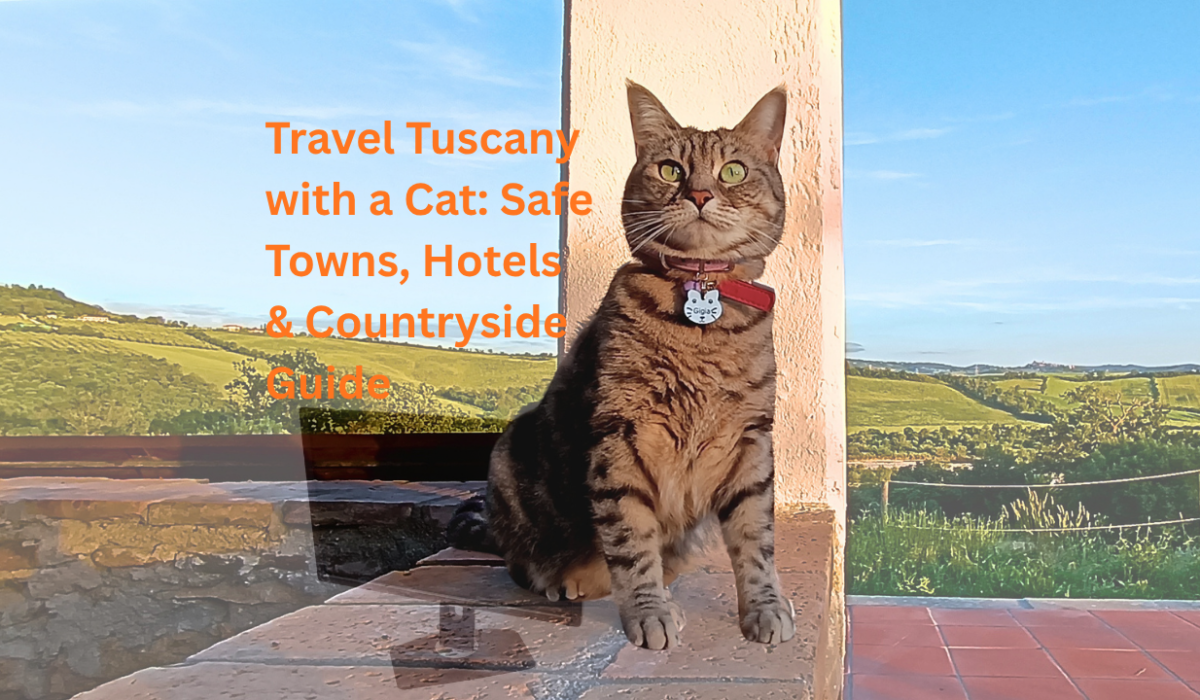
Gigia travelled through this part of Tuscany and demonstrated something important: rural freedom can be wonderful for a confident travelling cat—but it must remain controlled freedom.
Harnesses, supervision and knowledge of the immediate surroundings matter far more than the size of the landscape.
Best for: longer stays, countryside exploration and travellers who prefer a slower rhythm.
For more ideas about choosing peaceful destinations built around a slower pace, see our guide to Best Italian Hill Towns for Calm Travel.
🏛️ Lucca — One of the More Manageable City Bases
Lucca offers a useful contrast to rural Tuscany.
The historic centre is enclosed by its famous Renaissance walls, and the city’s relatively compact structure can make it easier to understand and navigate than a much larger urban destination.
That does not make Lucca automatically safe for an off-leash cat. Traffic, bicycles, crowds and unfamiliar surroundings still require supervision.
But as a city extension to a countryside stay, Lucca can work particularly well.
Best for: travellers who want history, cafés and urban exploration without committing to a large-city environment.
🏛️ Siena — Beautiful but More Demanding
Siena is spectacular, but its steep streets, steps, crowds and historic architecture mean that cat travel requires more planning.
For most feline travellers, Siena works better as a carefully chosen base or short visit rather than a destination to rush through.
Choose accommodation for calm and accessibility rather than simply proximity to Piazza del Campo.
🌆 Florence — Use the City Strategically
Florence can certainly be visited with a cat, but the centre is a very different proposition from rural Tuscany.
Crowds, traffic, pedestrian congestion and summer heat can make central Florence demanding.
A quieter neighbourhood or a base just outside the busiest historic streets may offer a better balance.
If Florence is part of a longer Tuscany journey, consider using it as a short urban extension rather than the entire focus of the trip. Our guide to How to Choose Quiet Neighborhoods in Italian Cities explains the feline-first thinking behind this approach.
Choosing Between Countryside and City
This is one of the most important decisions you will make.
🌿 Countryside
Advantages:
- More space
- Quieter surroundings
- Better suited to slow travel
- More opportunities for controlled outdoor exploration
- Easy access to scenic drives and villages
Potential challenges:
- Unfenced land
- Rural roads
- Wildlife
- Farm animals
- Free-roaming dogs or other pets
- Remote veterinary access
For a deeper look at why rural Italy can be particularly stimulating for cats, read Why Cats Love the Italian Countryside.
🏛️ City
Advantages:
- More structured environments
- Restaurants, shops and services nearby
- Easier access to veterinary facilities
- Less dependence on a car
Potential challenges:
- Traffic
- Crowds
- Noise
- Stairs and uneven surfaces
- Limited private outdoor space
The right choice depends on your cat, your accommodation and how much control you can maintain over the environment.
Where to Stay in Tuscany with a Cat
Accommodation is important enough to deserve its own strategy.
For the full property-by-property decision process, see our Tuscany Accommodation Guide for Cat Owners.
For the broader methodology behind choosing genuinely suitable feline accommodation in Italy, see How to Find Truly Cat-Friendly Accommodation in Italy.
🏡 Agriturismi
Agriturismi can be excellent for a slower Tuscany trip because they often combine accommodation with countryside surroundings.
But “agriturismo” describes a type of property, not a guarantee of feline suitability.
Before booking, check:
- Whether cats are explicitly accepted
- Whether the accommodation is self-contained
- Whether dogs or other animals roam freely
- Whether the property is fenced
- How close the nearest road is
- Whether windows and doors can be secured
For a broader guide to selecting these properties, see Finding a Cat-Friendly Agriturismo in Italy.
🏨 Boutique Hotels
Boutique hotels can work particularly well when you are extending a countryside trip with a short stay in Lucca, Siena or Florence.
Look for quiet rooms, secure windows, easy access and a clear policy that specifically includes cats rather than simply saying “pets welcome”.
For verified hotel examples across Italy, see our 20 Verified Cat-Friendly Hotels in Italy guide.
🏡 Villas & Private Rentals
Villas can provide exceptional privacy, but they require the most careful inspection.
A large garden may look ideal in photographs while presenting escape routes, open gates, neighbouring properties, roads or wildlife.
Before booking, ask the owner for photographs of entrances, windows, garden boundaries and the immediate surroundings.
Getting Around Tuscany with a Cat
🚗 Car Travel
For most countryside-focused Tuscany itineraries, travelling by car offers the greatest flexibility.
You control the timing, can avoid crowded transport hubs and can reach smaller villages and rural accommodation more easily.
But the journey itself should be treated as part of the cat’s travel experience.
- Use a secure carrier.
- Keep the carrier secured inside the vehicle.
- Never allow a cat to roam loose in the car.
- Plan regular breaks without exposing the cat to unsafe surroundings.
- Never leave a cat unattended in a parked car in warm weather.
For a complete guide to travelling by road, see How to Travel with a Cat by Car.
For carriers, portable litter solutions and other essentials, see our Best Cat Travel Gear guide.
🚆 Public Transport
Public transport is possible, particularly when connecting major cities, but it gives you less control over space, noise and timing.
If your Tuscany trip is primarily rural, a car is usually the more practical option. If your itinerary centres on Florence, Siena and Lucca, however, public transport may make sense for selected journeys.
How Long Should You Spend in Tuscany with a Cat?
Tuscany rewards slower travel.
Rather than changing accommodation every night, consider staying several nights in one place and using it as a base.
A simple structure could be:
- 3–4 nights: one countryside base
- 2 nights: countryside + Lucca or Siena
- 5–7 nights: one rural base plus one city extension
The exact number of nights should depend on your cat’s temperament and how comfortable she is with travel.
For many cats, one familiar room for four nights is preferable to four unfamiliar rooms in four nights.
This is the essence of Slow Travel in Italy: fewer relocations, more familiarity and more time for your cat to understand the environment.
Building a Cat-Friendly Tuscany Itinerary
The temptation is to collect destinations.
Florence. Siena. San Gimignano. Lucca. Val d’Orcia. Saturnia. Chianti.
But a cat does not experience Tuscany as a checklist.
Instead, build the journey around rhythm.
Example: Slow Southern Tuscany
- Base near Saturnia or Maremma
- Several slow countryside days
- Short drives to nearby villages
- Controlled outdoor exploration
- Return to the same accommodation each evening
Example: Countryside + City
- 3–4 nights in Chianti or another countryside base
- 2 nights in Lucca or Siena
- Optional Florence extension
This creates variety without asking your cat to constantly re-establish territory.
Seasonal Strategy for Tuscany with a Cat
🌸 Spring
Often an excellent period for exploring Tuscany, with milder temperatures and generally more comfortable conditions for outdoor activities.
Always check individual property conditions and local weather before travelling.
☀️ Summer
Summer brings heat, crowds and greater demand for accommodation.
Plan around the hottest parts of the day, choose accommodation with reliable temperature control and never underestimate the effect of heat on a cat travelling by car.
For a broader Italy-wide guide to managing heat, beaches and accommodation during the warmer months, see Travelling with a Cat in Italy in Summer.
🍂 Autumn
Autumn can be particularly attractive for slow countryside travel, with cooler temperatures and a different rhythm across the region.
❄️ Winter
Winter is quieter and can work beautifully for cats who prefer calm environments, although some rural properties and attractions operate seasonally.
Practical Tips for Traveling Tuscany with a Cat
- Choose fewer bases and stay longer.
- Confirm that your accommodation accepts cats specifically.
- Ask about dogs, farm animals and other pets on the property.
- Check roads and escape routes around rural accommodation.
- Secure windows and doors before allowing any exploration.
- Keep outdoor exploration supervised unless you have a genuinely secure enclosed area.
- Bring familiar bedding or another familiar-smelling item.
- Keep your cat’s routine as consistent as possible.
- Carry familiar food, litter and essential supplies.
- Know where the nearest veterinary service is before arriving.
If Tuscany is your first cat-friendly trip to Italy, our Before Travelling to Italy With Your Cat guide can help you work through the practical preparation before you leave home.
🐾 Gigia’s Tuscany Experience
Gigia’s experience of Tuscany changed the way I thought about feline travel.
In a city, a cat often experiences the world through a relatively narrow corridor of streets, buildings, cafés and transport.
In the countryside, the environment becomes much larger.
There are fields to observe, birds to watch, insects to investigate, unfamiliar smells and changing sounds. That can make travel richer—but it also means there are more variables for the human to manage.
For Gigia, Tuscany became a place of active exploration rather than passive observation.
That is perhaps the greatest lesson of travelling Tuscany with a cat:
The landscape itself becomes part of the experience.
How Tuscany Fits Into a Wider Italy Trip
Tuscany works particularly well as part of a slower multi-region itinerary.
You might combine it with Rome for a strong contrast between urban and rural Italy, or use northern destinations as a practical transition point.
If Rome is part of the same journey, our Cat-Friendly Holidays in Italy: The Ultimate Rome & Lazio Itinerary provides the corresponding regional guide.
The important thing is not to make every stop another relocation.
For broader transport planning, regional strategy and travelling throughout the country, see our Ultimate Guide to Traveling Italy with Your Cat.
🐾 Gigia’s Final Verdict
Tuscany is not a destination to conquer.
It is a destination to settle into.
Choose a thoughtful base, reduce unnecessary movement, supervise outdoor exploration and give your cat time to understand each new environment.
Do that, and Tuscany can become one of the most rewarding places in Italy to experience together.
For the practical accommodation decision process, continue to our Tuscany Accommodation Guide for Cat Owners.