

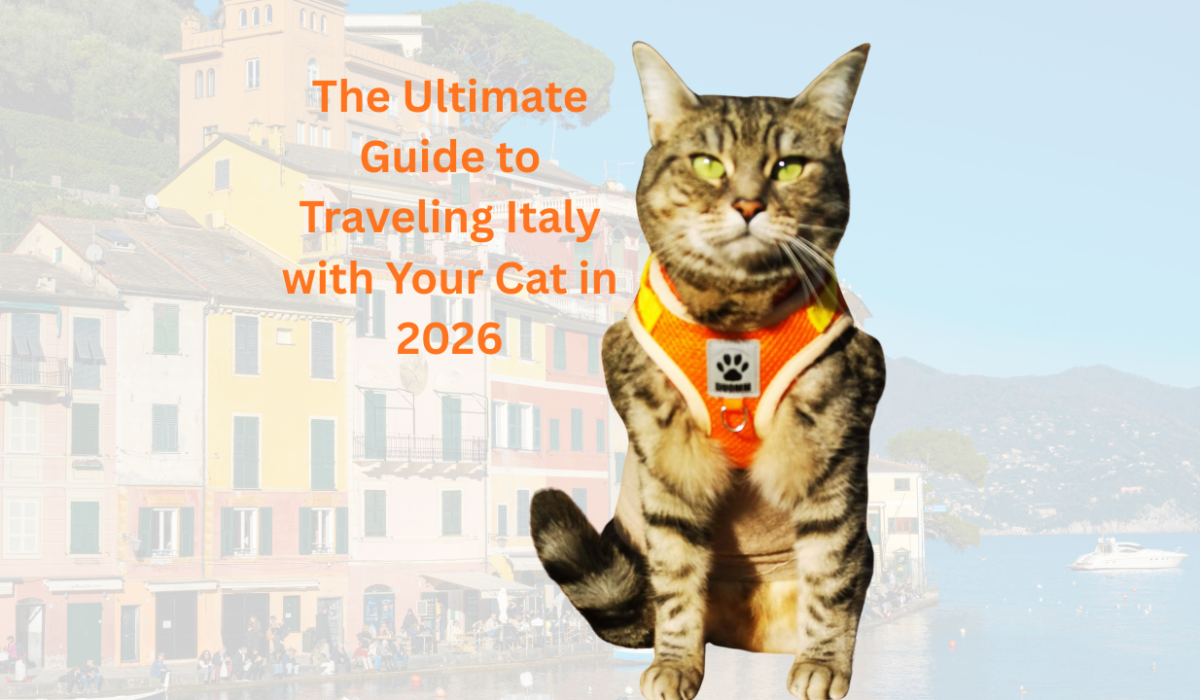
Traveling to Italy With a Cat: The Ultimate 2026 Guide
Traveling to Italy with a cat in 2026 is absolutely possible — but it takes more thought than simply booking a flight and finding a pet-friendly hotel.
From entry documentation and airline cabin rules to choosing quiet accommodation, managing transport and helping your cat settle into unfamiliar surroundings, successful feline travel depends on preparation, flexibility and, above all, understanding the animal you are travelling with.
Most pet-travel advice is designed around dogs: outdoor cafés, hiking trails, long walks and energetic itineraries. Cats often need something different — calm transitions, predictable routines, secure spaces, familiar smells and plenty of opportunities to retreat from stimulation.
That does not mean travelling with a cat has to be complicated.
In fact, once you begin planning the journey around your cat rather than simply taking your cat along on a conventional holiday, Italy can become an extraordinarily rewarding destination.
This guide brings together the practical side of travelling to Italy with a cat — including entry requirements, transport, accommodation and preparation — with the feline-first approach I have developed through travelling across Italy with Gigia.
Whether you are planning a short city break, a road trip or a longer slow-travel adventure, the aim is the same:
to make Italy not only somewhere your cat can visit, but somewhere your cat can actually experience.
Can You Travel to Italy With a Cat?
Yes — but the exact requirements depend on where your journey begins, how you travel and which transport operators you use.
For cats entering Italy from another EU country, the journey generally involves the appropriate identification, rabies vaccination and EU pet-travel documentation.
For cats arriving from outside the EU, additional documentation and entry procedures may apply.
At a minimum, you should expect to deal with:
- an ISO-compliant microchip
- a valid rabies vaccination
- an EU Pet Passport or the appropriate official health documentation
- an airline- or transport-approved carrier
However, meeting Italy’s entry requirements is only one part of the journey.
Your airline may impose its own restrictions on:
- carrier dimensions
- combined pet-and-carrier weight
- the number of animals permitted in the cabin
- advance pet reservations
- whether your particular aircraft accepts pets
- and whether the animal can travel in the cabin at all.
Similarly, train, ferry, taxi and accommodation policies can vary between operators and properties.
Think of the journey as two separate questions:
- Can my cat legally enter Italy?
- Will every company and property involved in my journey accept my cat under its own current rules?
You need a “yes” to both.
And there is another important distinction.
Italy is widely regarded as a pet-friendly country, but “pet-friendly” does not necessarily mean “cat-friendly.”
A hotel that accepts dogs may not understand the needs of an indoor cat. A rural property may welcome animals but have unsecured doors, balconies or resident dogs. A beautiful apartment may be unsuitable because of a noisy street directly below the bedroom.
For a cat, the details matter.
Italy Entry Requirements for Cats in 2026
Before booking flights or accommodation, make sure you understand the entry requirements that apply to your specific country of departure.
Pet-travel regulations can change, and requirements may differ depending on whether you are travelling within the EU or entering the EU from a non-EU country.
For that reason, always verify the current requirements with the relevant official government or EU authority and, where appropriate, your veterinarian before departure.
Microchip
Your cat should be identified with an appropriate microchip that complies with the relevant EU requirements.
One particularly important point is the relationship between identification and rabies vaccination.
Where the EU rules require it, the microchip must be implanted before the qualifying rabies vaccination.
If your cat was vaccinated before being correctly identified, do not assume the vaccination will automatically satisfy the entry requirements. Ask your veterinarian to check your cat’s records well before you travel.
Rabies Vaccination
A valid rabies vaccination is an essential part of EU pet travel requirements for cats arriving from countries where vaccination is required.
Depending on your circumstances, you may need to ensure that:
- the cat is correctly identified;
- the rabies vaccination is valid;
- the vaccination was administered after the required identification;
- and, for a first qualifying vaccination, the appropriate waiting period has elapsed before travel.
The familiar 21-day waiting period is particularly important for first vaccinations, but do not apply it blindly to every journey: the rules surrounding previous valid vaccinations and entry from different countries can differ.
EU Pet Passport or Health Certificate
Your documentation depends largely on where you are travelling from.
If travelling within the EU
An appropriate EU Pet Passport is generally the key document for travelling with your cat between EU countries.
If travelling into the EU from outside the EU
You may instead need an official animal health certificate and additional documentation or certification, depending on the country from which you are arriving.
Some countries also have additional requirements.
Do not leave this paperwork until the last minute.
Keep:
- the original documents;
- printed copies;
- digital photographs or scans;
- and your veterinarian’s contact details.
For a more detailed preparation timeline, see our Before Travelling to Italy With Your Cat: The Complete Pre-Trip Checklist.
And for the practical realities of flying, including airline-specific considerations, see our Flying to Italy with a Cat: Airline & EU Entry Rules guide.
Flying to Italy With a Cat
For many international travellers, the flight is the most complicated part of the journey.
It is also the stage where planning matters most.
Airlines have their own rules, and these can change. Never assume that because one airline accepts cats in the cabin, another will do the same.
Cabin Travel Rules
Where an airline permits cats to travel in the cabin, you may need to meet requirements concerning:
- carrier dimensions;
- combined pet-and-carrier weight;
- the carrier’s construction;
- placement under the seat;
- advance booking;
- and the number of animals permitted on a particular flight.
Some airlines also restrict pets according to aircraft type, route or destination.
That is why the safest approach is to check the current rules of the actual airline and flight you are booking, rather than relying on a general “cats can fly in cabin” rule.
Reserve Your Cat’s Place Early
A particularly important practical point is that a flight may have a limited number of animals permitted in the cabin.
Buying your own ticket does not necessarily guarantee that your cat can travel on the same flight.
Once you have identified a suitable flight, check the airline’s pet-booking procedure and confirm your cat’s reservation as early as possible.
Gigia’s Flight Strategy
Gigia travels with a structured soft-sided backpack carrier.
For us, the carrier is much more than something that transports her from A to B.
It is a portable sanctuary.
The familiar carrier gives Gigia somewhere predictable to retreat to when the environment becomes overwhelming.
Our priorities are:
- secure construction
- good ventilation
- comfortable weight distribution
- easy access for reassurance
- a familiar interior
- the ability for Gigia to observe her surroundings without being exposed to everything at once
The most important lesson I have learned is that the carrier should become familiar before the journey.
It should not first appear on the morning of departure.
Getting Around Italy With a Cat
Once you arrive in Italy, the journey does not suddenly become effortless.
You still have to consider how your cat will move between airports, stations, hotels and destinations.
The good news is that Italy offers several ways to travel with a cat — provided you check the current rules of the operator you are using.
Trains: Frecciarossa, Italo and Regional Services
Cats can travel on Italian trains under operator-specific conditions, generally involving an appropriate carrier.
However, rules can differ according to:
- train operator;
- service;
- ticket type;
- carrier dimensions;
- and sometimes the size or location of the carrier.
Always check the current conditions before travelling.
For Gigia, however, the practical question is not simply whether she is allowed on the train.
It is whether the journey will be comfortable.
Gigia’s Train Tip
When possible, I favour quieter journeys and less crowded environments.
Reduced noise and fewer sudden movements can make a significant difference to a sensitive cat.
For a long journey, a quieter environment may matter more than choosing the most expensive seat.
For a detailed look at train travel, carriers and practical strategies, see our Complete Guide to Travelling with a Cat by Train in Italy.
Taxis & Ride Services
Never assume that every taxi or private driver will automatically accept an animal.
A cat travelling securely inside a carrier is much easier to accommodate than a loose animal, but the driver should still know what to expect.
Simple rule:
Never surprise the driver.
When booking, mention that you are travelling with a cat in a secure carrier and confirm that the driver is happy to accept the journey.
A small towel or absorbent mat underneath the carrier is also a thoughtful precaution.
Ferries & Boats
Ferry policies vary considerably between companies and routes.
Some may permit cats in carriers in designated passenger areas; others may have specific pet cabins or restrictions.
For longer journeys, especially routes involving Sicily or Sardinia, investigate the available options before booking.
If your cat is likely to become stressed by crowds and unfamiliar surroundings, a private or designated pet-friendly cabin may be worth considering.
Venice Vaporetto Travel
Venice deserves special mention because public transport is such an integral part of the city.
Cats can travel on ACTV services subject to the operator’s current conditions, with secure containment being an important consideration.
For a smoother journey:
- avoid the busiest periods where practical;
- allow extra time for boarding;
- keep your cat securely contained;
- choose quieter routes and times where possible;
- and give your cat time to adjust to the movement and sounds of the boat.
Travelling by Car
If you are driving to or around Italy, you have much greater control over the pace of the journey — but that does not mean you can simply put a cat in the car and start driving.
Carrier security, temperature, ventilation, rest stops and journey length all matter.
For a complete guide to preparation, carrier safety and travelling by road, see How to Travel with a Cat by Car: The Complete Guide.
Choosing the Right Basecamp
Your accommodation may be the single most important decision of the entire trip.
A poorly chosen hotel can create more stress than a long flight.
This is why I recommend thinking of accommodation as your cat’s basecamp, rather than simply somewhere to sleep.
Forget generic “pets allowed” filters.
Instead, ask:
Would my cat actually be secure here?
If you are comparing hotels specifically, our Where to Stay in Italy with a Cat guide explains how to evaluate a property before booking.
What Makes Accommodation Cat-Friendly?
Quiet surroundings
A beautiful apartment on a nightclub street may be a terrible choice for a cat.
Look at:
- traffic;
- nightlife;
- nearby restaurants;
- pedestrian crowds;
- construction;
- and the general noise level.
Secure windows and balconies
A balcony with a beautiful view is not necessarily a safe balcony for a cat.
Check how windows open, whether screens are secure and whether there are accessible escape routes.
Self-contained layouts
Apartments, suites and other self-contained spaces can sometimes work particularly well for cats because they provide a predictable environment with fewer unfamiliar people passing through.
Low traffic
Busy hotel corridors, lifts, breakfast rooms and constant housekeeping activity may create unnecessary stimulation.
A quieter room away from the busiest parts of the property can sometimes make a remarkable difference.
Questions to Ask Before Booking
Do not be afraid to message the property directly.
Ask:
- Are the windows and balconies secure?
- Is the room or apartment quiet at night?
- Are there resident dogs or other animals on the property?
- Is the property close to heavy traffic or nightlife?
- Can you recommend the quietest room or unit?
The quality of the answers can tell you almost as much as the answers themselves.
A host who takes the time to understand your questions is often a much better sign than a large “pets welcome” badge.
For a deeper guide to vetting properties, see our How to Find Truly Cat-Friendly Accommodation in Italy.
Best Types of Accommodation for Cats
Different types of accommodation suit different journeys.
Hotels
Best for:
- short stays;
- city breaks;
- travellers who value convenience;
- access to reception or concierge services.
Advantages:
- easy logistics;
- housekeeping;
- central locations;
- professional support.
Potential disadvantages:
- less space;
- more people coming and going;
- stricter pet policies;
- more noise.
For a short city stay, a carefully chosen hotel can work extremely well.
Apartments & Rentals
Best for:
- longer stays;
- routine stability;
- privacy;
- cats that need time to settle.
An apartment can give your cat a defined territory and reduce the number of daily interactions with strangers.
But security matters enormously.
Always check doors, windows, balconies and access points before allowing your cat to explore.
Agriturismi
Agriturismi can be wonderful for slow travel.
The right property may offer:
- peaceful surroundings;
- thick stone walls;
- independent accommodation;
- outdoor views;
- fewer neighbours;
- and a slower rhythm.
But rural does not automatically mean suitable for cats.
An open property with unsecured doors, roaming dogs, livestock or easy access to roads may present more risks than a well-managed city apartment.
For more advice, see our guide to Finding a Cat-Friendly Agriturismo in Italy.
For a broader look at why the countryside can suit feline travel, read Why Cats Love the Italian Countryside.
Preparing Your Cat for Travel
The biggest mistake cat guardians make?
Testing travel on departure day.
A cat does not suddenly become comfortable with a carrier, car, train or unfamiliar hotel because you have bought the ticket.
Preparation should begin well before departure.
If you are starting from scratch, our Before Travelling to Italy With Your Cat: The Complete Pre-Trip Checklist takes you through the process step by step.
And if you want to understand the broader lessons I have learned through travelling with Gigia, see our Feline Influencer’s Guide: Expert Cat Travel Lessons from Gigia.
Carrier Training
Leave the carrier open at home.
Make it part of the environment rather than an object that appears only before unpleasant experiences.
You can add:
- treats;
- a familiar blanket;
- bedding carrying your cat’s scent;
- a favourite toy.
The goal is simple:
Carrier = safe den.
Not forced confinement.
If your cat voluntarily enters the carrier at home, the journey starts from a much better place.
Build a Scent Bridge
Cats experience the world through scent to an extraordinary degree.
That makes familiar smells valuable when travelling.
Bring:
- a favourite blanket;
- a worn T-shirt;
- familiar bedding;
- or another safe item carrying the scent of home.
When you arrive somewhere new, these familiar smells can help create a small island of familiarity inside an unfamiliar environment.
The aim is not to make the new place smell like home.
It is to give your cat something recognisable within it.
Essential Cat Travel Packing List
Every cat is different, but some items consistently make feline travel easier.
Your cat travel kit may include:
- airline-approved or transport-approved carrier
- foldable litter tray
- litter liners
- familiar litter
- collapsible water and food bowls
- usual food
- treats
- harness and leash, if your cat is comfortable using them
- favourite toy
- familiar bedding
- cleaning wipes
- enzyme cleaner
- medical and travel documents
- copies of important records
I also recommend packing more familiar food and litter than you think you will need, particularly if you are travelling between several destinations.
A cat may cope beautifully with a change of scenery and still object strongly to a sudden change in food or litter.
For the equipment I actually use with Gigia, see Best Cat Travel Gear: Gigia’s Must-Have Essentials.
Best Cat-Friendly Destinations in Italy
Italy is not one single experience.
Some destinations are much better suited to feline travel than others — particularly if your cat prefers calm surroundings and slower transitions.
Venice
Venice can be surprisingly rewarding with a cat when approached slowly.
Rather than attempting to cover every major attraction, think in terms of:
- quiet mornings;
- atmospheric neighbourhoods;
- short outings;
- secure transport;
- and plenty of time back at your accommodation.
Areas such as Castello, Cannaregio and Dorsoduro can offer a different experience from the busiest tourist centre, although the suitability of any particular street or property depends on its exact location.
I would be cautious about choosing the busiest part of San Marco as your base if your priority is a quieter environment.
For more detail, see our Venice with a Cat guide.
And if accommodation is your main concern, see Where to Stay in Venice with a Cat.
Treviso
Treviso is one of my favourite examples of a destination that can work beautifully for slower feline travel.
It offers:
- canals;
- historic streets;
- a more relaxed atmosphere than Venice;
- and easy access to the surrounding Veneto region.
It can also make an excellent base for exploring beyond the city without changing accommodation every night.
See our guide to the 15 Best Day Trips from Treviso for ideas.
Tuscany
Tuscany is particularly well suited to travellers who want to slow down.
Think:
- agriturismi;
- vineyards;
- hill towns;
- countryside accommodation;
- longer stays;
- and fewer daily transfers.
The key is not to turn Tuscany into a checklist.
Choose one comfortable base and explore from there.
For deeper planning, see Tuscany with a Cat: Where to Stay, What to Know & How to Travel Smart.
For accommodation specifically, see our Tuscany Accommodation Guide for Cat Owners.
Abruzzo
Abruzzo is one of Gigia’s favourite regions for calm travel.
Its combination of villages, landscapes and slower rhythms makes it particularly interesting for travellers who want to experience a less crowded side of Italy.
The region offers:
- expansive landscapes;
- historic villages;
- mountain scenery;
- fewer international tourists in many areas;
- and opportunities for slower, nature-oriented travel.
Rome & Lazio
Rome is certainly possible with a cat, but it takes more planning than a quiet rural destination.
The city can involve:
- traffic;
- crowds;
- noise;
- busy public transport;
- and long stretches of stimulation.
For that reason, I would prioritise a quiet residential base over staying directly beside the most famous attractions.
Look for:
- quieter streets;
- secure accommodation;
- easy access to green spaces or quiet walking routes;
- and a manageable distance from the areas you actually want to visit.
For a complete trip-planning approach, see our Cat-Friendly Rome & Lazio Itinerary.
If accommodation is your priority, our Booking Cat-Friendly Hotels in Rome guide covers the practical questions to ask before choosing a property.


2 Comments
It’s good to see more resources finally focusing on cat travel, since it’s often an afterthought—I actually found some related pet-friendly destination ideas on https://tinyfun.io/game/pac-man-halloween-2025-edition. Hopefully 2026 will bring even more options for feline adventurers.