
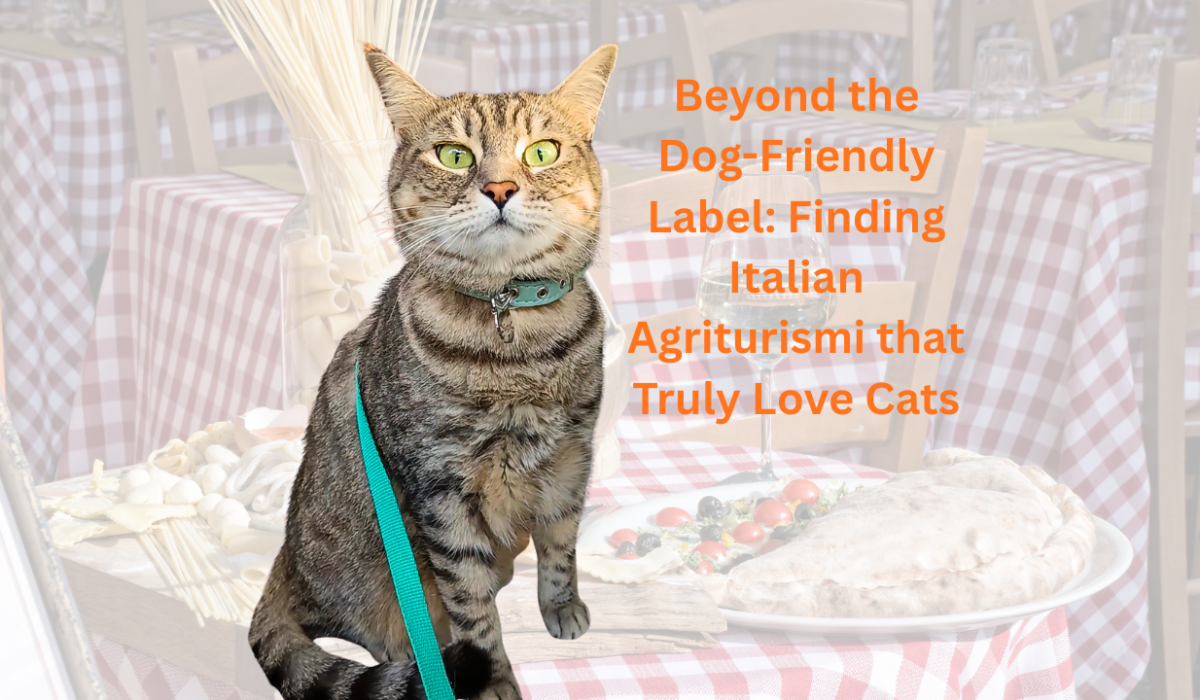
Finding a Cat-Friendly Agriturismo in Italy: Beyond the Dog-Friendly Label
If you dream of waking up beside an Italian vineyard, olive grove or rolling hillside with your cat curled up beside you, an agriturismo can be one of the most rewarding ways to experience Italy together.
But there is a catch.
Searching for an agriturismo pet friendly or agriturismo gatti ammessi is not quite the same thing as finding accommodation that is genuinely suitable for a cat.
Many Italian countryside properties welcome animals but have designed their hospitality primarily around dogs. Open lawns, farm animals, swimming pools and outdoor access may sound wonderful to a human traveller. For a cat, they can introduce escape routes, unfamiliar animals, roads, wildlife and a great deal of sensory stimulation.
That is why the question should not simply be “Does this agriturismo allow pets?”
This guide explains how to find a genuinely cat-friendly agriturismo in Italy, what to check before booking, which types of countryside properties tend to work best, and how to distinguish feline-friendly hospitality from a generic “pets allowed” label.
Start with our Ultimate Guide to Traveling Italy with Your Cat for the broader journey, then use this guide when you are ready to choose a countryside stay.
What Is an Agriturismo?
An agriturismo is a type of Italian rural accommodation connected to an agricultural property. Depending on the region and property, that can mean anything from a working farm with a handful of rooms to a beautifully restored farmhouse offering independent apartments, gardens, vineyards or olive groves.
For cat travellers, that variety matters enormously.
Two properties can both describe themselves as pet-friendly while offering completely different environments.
| Property Type | Potential Advantage for Cats | What to Check |
|---|---|---|
| Self-contained farmhouse apartment | Privacy and predictable surroundings | Windows, doors and outdoor access |
| Small owner-run agriturismo | Personalised hospitality | Resident animals and guest interaction |
| Large rural estate | Space and beautiful surroundings | Escape routes, dogs and shared areas |
| Farmhouse with private courtyard | Controlled outdoor stimulation | Whether the courtyard is genuinely enclosed |
For a cat, the physical design of the property can matter more than its star rating.
Why “Pet-Friendly” Is Not Enough for Cats
The phrase “pet-friendly” tells you remarkably little.
It may mean that a dog can stay for an additional fee. It may mean that animals are accepted only in certain rooms. It may mean that pets cannot enter communal areas. Or it may simply mean that the owner is willing to make an exception.
None of those answers tells you whether the property works for your particular cat.
During countryside travel, Gigia taught us to look at accommodation differently. A beautiful property can become a poor choice if its doors open directly onto an unfenced garden, if dogs roam freely around the grounds, or if windows cannot be secured.
The objective is not to prevent your cat from experiencing the countryside.
It is to create controlled freedom—an environment in which your cat can observe, explore and settle without being exposed to unnecessary risks.
The feline-friendly test
- Can your cat remain safely indoors?
- Can windows and doors be secured?
- Is there a quiet place for the litter box?
- Can you control interaction with dogs and other animals?
- Does the accommodation have a private or independent entrance?
What Makes an Agriturismo Truly Cat-Friendly?
After travelling extensively with Gigia, we have learned that several characteristics consistently make rural accommodation easier for feline travellers.
1. A Self-Contained Accommodation Unit
This is one of the most useful features to look for.
An independent apartment or farmhouse suite gives your cat a clearly defined territory. There is less hallway traffic, fewer unfamiliar smells and less chance of doors opening unexpectedly.
It also makes it easier to establish your cat’s normal routine as soon as you arrive.
Look for:
- private entrances
- independent kitchens or living areas
- minimal shared corridors
- clearly defined outdoor boundaries
2. Secure Windows, Doors and Outdoor Areas
Country accommodation often comes with beautiful terraces and large windows. That is wonderful for humans—but potentially dangerous for a curious cat.
Before booking, ask specifically whether:
- windows can be opened safely
- screens or shutters are available
- terraces are enclosed
- doors open directly onto gardens
- the property borders roads or open countryside
Do not assume that a property described as “private” is escape-proof.
3. Quiet Sleeping and Hiding Areas
One of the greatest advantages of an agriturismo is the possibility of space.
Your cat does not necessarily need a huge room. What matters is having somewhere quiet where she can retreat when unfamiliar people arrive, housekeeping takes place or outdoor activity becomes stimulating.
A good rural property should allow your cat to choose when to observe and when to withdraw.
4. Hosts Who Understand Cats
This is perhaps the hardest quality to identify from a booking platform.
A host who says, “Of course, we accept cats” is giving you useful information.
A host who immediately asks about your cat’s routine, sleeping arrangements or whether you need a quiet unit is giving you something much more valuable: evidence that they understand feline guests.
That distinction is one of the reasons we recommend contacting rural properties directly before confirming a booking.
The Best Italian Regions for a Cat-Friendly Agriturismo
Italy offers extraordinary variety when it comes to rural accommodation. Some regions are particularly appealing for travellers looking for slower, lower-stimulation countryside experiences.
🌿 Umbria — Quiet Countryside and Space
Umbria can be an excellent choice for cats who prefer quieter environments.
Compared with Italy’s most heavily visited destinations, many parts of Umbria offer:
- quieter roads
- lower-density countryside
- independent rural properties
- easy access to small historic towns
- a slower pace of travel
Best for: cautious cats, longer stays and travellers seeking genuine slow travel.
🍷 Tuscany — Beautiful, But Choose Carefully
Tuscany is perhaps the most obvious destination for an Italian agriturismo—and for good reason.
Historic farmhouses, vineyards, olive groves and restored country estates can make extraordinary bases for a cat-friendly holiday.
But popularity creates another consideration: not every picturesque property is equally suitable for feline travellers.
Prioritise:
- self-contained apartments
- secure courtyards
- smaller properties
- quiet locations away from major roads
- clear information about resident animals
For a dedicated regional guide, see our Tuscany with Your Cat guide.
🚜 Emilia-Romagna — Practical Rural Travel
For travellers who want countryside without being completely remote, Emilia-Romagna can be a useful balance.
The region combines rural landscapes with good transport connections, historic towns and practical amenities.
Best for: road trips, travellers combining city and countryside stays, and anyone who prefers having services within relatively easy reach.
Gigia’s Five Questions to Ask Before Booking
Never rely entirely on a booking-platform pet filter.
Once you have shortlisted a property, contact the host directly and ask these five questions:
- Do you specifically accept cats? Not simply dogs or pets in general.
- Is the accommodation completely self-contained? Ask about entrances, shared areas and access to the grounds.
- Can windows and doors be secured? This is particularly important in older farmhouses.
- Are there resident dogs, cats or other animals on the property? Find out whether they roam freely.
- Where would you recommend placing the litter box? The answer can reveal a surprising amount about how familiar the host is with cats.
How to Find Cat-Friendly Agriturismi Online
Booking platforms are useful—but use them as discovery tools rather than final verification tools.
Start by searching platforms such as:
- Booking.com
- Airbnb
- Vrbo
Use the relevant pet-friendly filter to create your initial shortlist.
Then investigate each property individually.
Look carefully at:
- photographs of windows and terraces
- floor plans or descriptions of the accommodation
- reviews mentioning animals
- the property’s location relative to roads
- information about resident dogs or farm animals
Finally, contact the property directly before booking.
This extra step is particularly valuable with small, family-run agriturismi. Owners may be more flexible than a platform listing suggests and may be able to recommend a quieter apartment or explain exactly how the property works.
For the broader methodology of evaluating accommodation throughout Italy, see our How to Find Truly Cat-Friendly Accommodation in Italy guide.
Premium Agriturismo or Budget Farm Stay?
Not every countryside trip requires a luxury estate.
The right property depends on what matters most to you and your cat.
| Stay | Best For | Typical Priority |
|---|---|---|
| Premium Agriturismo | Slow travel with more space and privacy | Privacy, architecture and service |
| Family-Run Farm Stay | Personal hospitality | Quietness and flexibility |
| Budget Farm Stay | Longer or lower-cost trips | Value and practicality |
| Luxury Country Estate | Special occasions | Space, privacy and amenities |
If keeping costs down is your priority, our separate Budget-Friendly Pet-Friendly Farm Stays in Italy guide focuses specifically on affordability, family-run properties and longer-stay value.
This article, by contrast, is about how to identify a genuinely suitable agriturismo for a cat, regardless of budget.
How to Settle Your Cat Into an Agriturismo
Arriving at a rural property can be exciting for humans and overwhelming for cats.
Give your cat time to establish the accommodation as her territory before introducing unnecessary stimulation.
On arrival:
- Keep your cat safely inside the accommodation.
- Set up familiar litter, food and water immediately.
- Place a familiar blanket or bed somewhere quiet.
- Allow your cat to explore the interior at her own pace.
- Keep windows and exterior doors secured until you understand the property.
Do not assume that a cat who enjoys travelling wants immediate access to the garden.
Sometimes the best first day in the Italian countryside is simply a quiet one.
Pack for an Agriturismo Stay
- Familiar litter and litter tray
- Food and water bowls
- Favourite blanket or bed
- Secure carrier
- Harness and lead if your cat is trained to use them
- Portable scratching surface
- Basic cleaning supplies
For a more complete packing list, see our Best Cat Travel Gear guide.
Building an Agriturismo Into a Cat-Friendly Italy Itinerary
A countryside stay works particularly well as part of a slower multi-stop journey.
Instead of changing accommodation every night, consider staying several nights in one rural property and using it as a base.
Some useful combinations include:
- Tuscany + Florence: countryside followed by Renaissance culture.
- Umbria + Rome: rural surroundings before returning to the Eternal City.
- Veneto countryside + Venice: a quieter base combined with time in one of Italy’s busiest destinations.
The principle is simple: build pauses into the journey. Cats often benefit more from staying several nights in one secure territory than from constantly moving between beautiful destinations.
When an Agriturismo Is the Wrong Choice
Despite their appeal, agriturismi are not automatically better for cats than hotels.
A countryside property may be a poor choice if:
- your cat is highly reactive to unfamiliar animals
- the property has unrestricted outdoor access
- dogs roam freely around guest accommodation
- windows cannot be secured
- the accommodation opens directly onto a road
- there are many shared communal areas
- the owner cannot clearly explain the property’s pet policy
In those circumstances, a carefully selected hotel or self-contained apartment may actually be more suitable.
For a broader comparison of accommodation types, see our Where to Stay in Italy with a Cat guide.
Final Thoughts: Choose the Property, Not the Label
An Italian agriturismo can give you something a conventional hotel cannot: the experience of having a temporary home in the countryside.
You wake to birdsong instead of traffic.
You watch the light move across vineyards and olive trees.
You have space to slow down.
And, if the property is chosen carefully, your cat can enjoy that slower rhythm too.
But don’t let a beautiful photograph make the decision for you.
Look beyond the words pet-friendly.
Ask about the windows.
Ask about the dogs.
Ask about the doors.
Ask about the litter box.
Ask whether the accommodation is genuinely self-contained.
It is the property where your cat can safely relax, observe the countryside and remain in control of her own environment.
That is the difference between simply taking a cat to the Italian countryside and travelling through Italy in a way that works for the cat, too.


6 Comments